Towada-Hachimantai National Park: Hot-Spring Bathing for the Wild at Heart
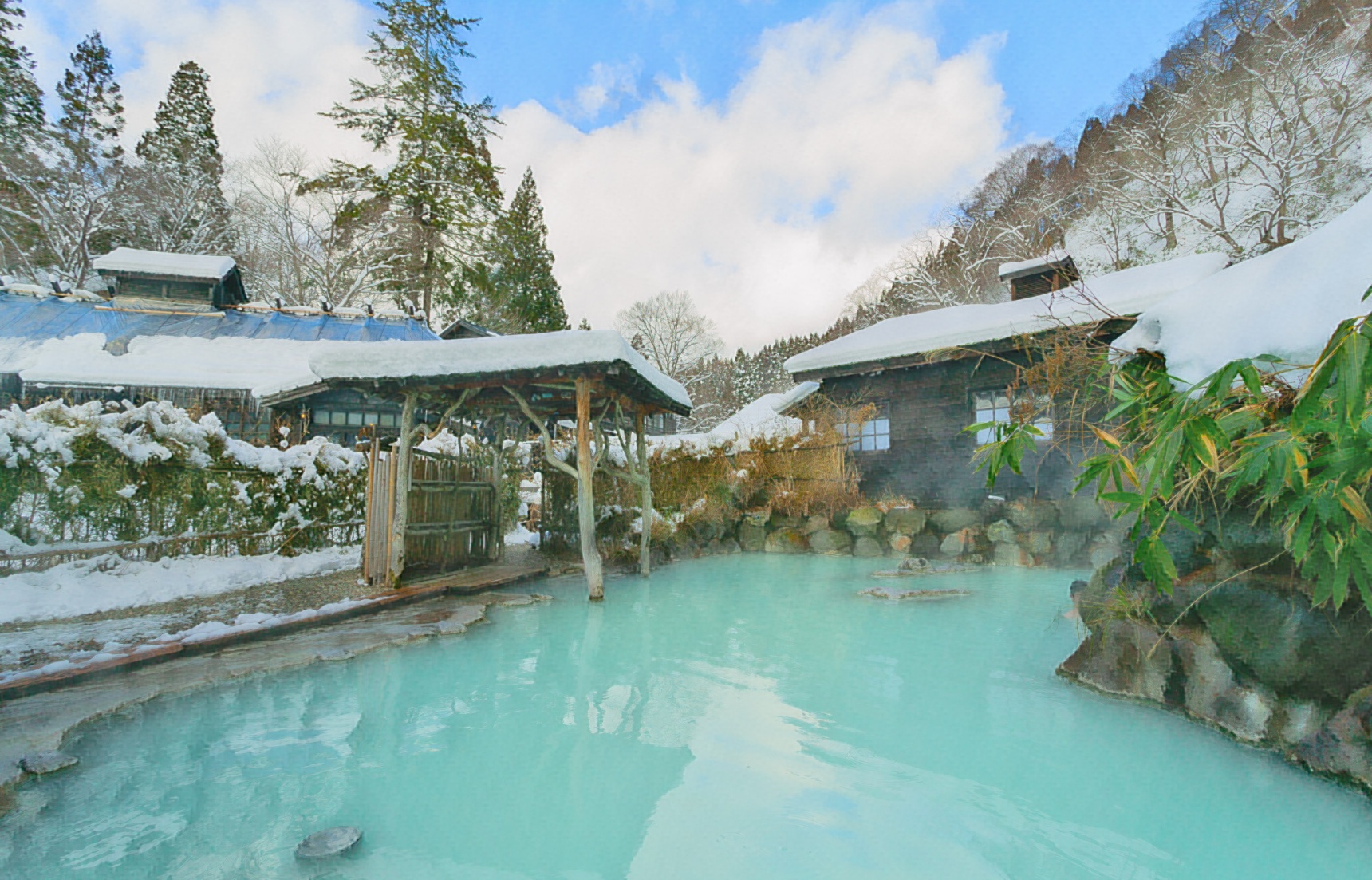
Tsuru-no-Yu Hot Springs: Mixed-Gender Open-Air Bath (pixta)
Mixed bathing still flourishes in northeastern Japan. Giles Murray visited several hot spring resorts in Towada-Hachimantai National Park to discover the pleasures—and occasional awkwardness—of bathing together in the buff.
By Giles Murray
The first couple of years I lived in Japan, I was so eager to learn Japanese that I spent a full quarter of my meager English-teacher’s salary on intensive language courses. Careful budgeting was required. One way I economized was by living in a super-cheap apartment without a bath, instead going to the local public bath, or sento, every day. While many of my foreign friends apparently found the idea of bathing with strangers rather off-putting, years of communal showering at an English boarding school meant that the public bath held no terrors for me.
But in Japan there is a level of communal nudity beyond the sento: the mixed bathing of men and women, known as konyoku. Although the government banned mixed bathing in towns in the 1860s in a concession to Victorian prudery, the practice remained popular in the countryside. This was particularly true in the Tohoku region in northeastern Japan, where farming families traditionally decamped en masse to hot springs during the agricultural off-season. Unburdened by the neuroses of the urban bourgeoisie, these country folk had no inhibitions about getting their kit off in front of their peers. They would stay at the hot springs for weeks on end, doing their own catering to bring down the bill.
My wife and I hatched a plan to drive down through Towada-Hachimantai National Park from north to south, staying in a selection of mixed-bathing hot-spring inns en route. (For all its fearsome reputation, konyoku is actually very couple-friendly.) Famous for its mountains, volcanoes, fumaroles, and beech forests, the park has two main sections: a northern area, encompassing Lake Towada, Oirase Gorge and the Hakkoda Mountains, and a southern area encompassing Mt. Hachimantai and Mt. Iwate.
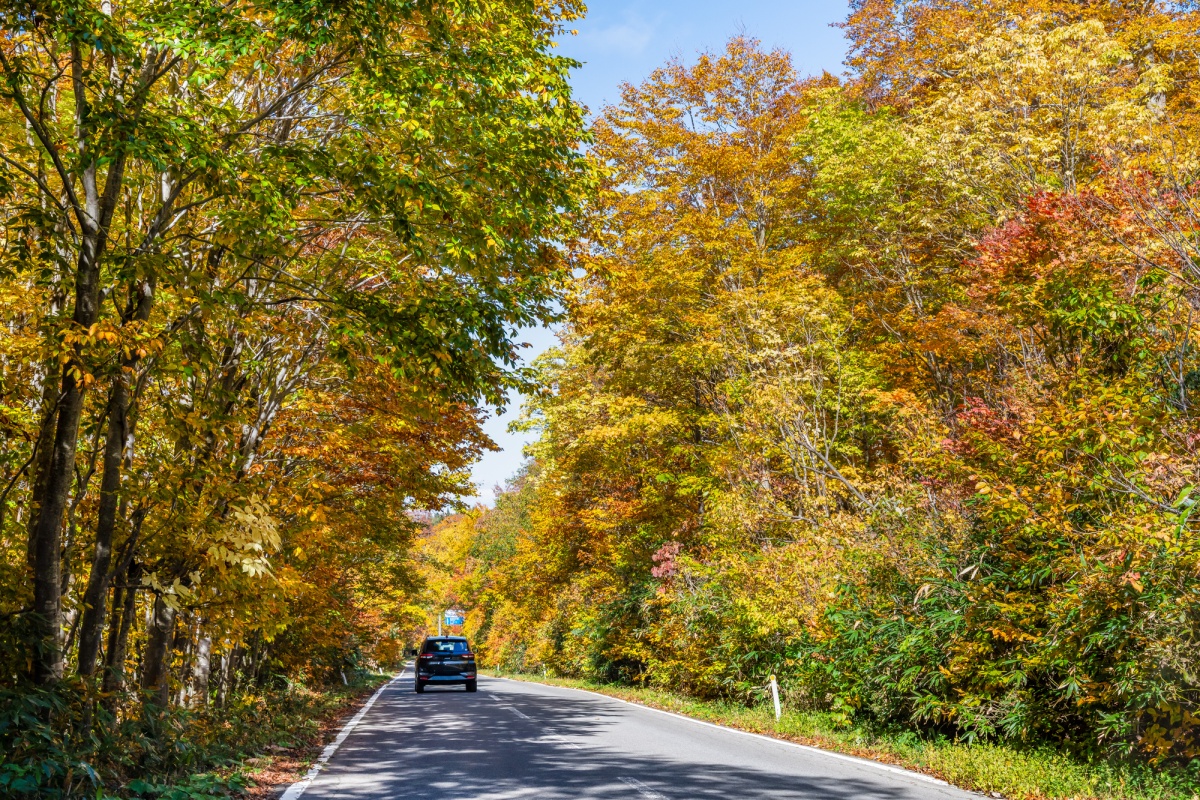
Towada-Hachimantai National Park is enjoyable in all seasons, but particularly striking when bathed in Autumn colors. (pixta)
After renting a car at Shin-Aomori Station, a drive of just under an hour and a half took us to our first stop: Sukayu Onsen. Situated on a roadside on the flanks of the Hakkoda Mountains, Sukayu Onsen is probably the best place to confront one’s fears about mixed bathing full on and acquire rapid “nudity immunity.” While many of the hot spring inns in the national park are rustic, ramshackle, modest and quiet, Sukayu, with 140 rooms and accommodation for 250 guests, is on an entirely different scale. The same is true of its indoor mixed bath, the evocatively named “Bath for a Thousand Bathers,” a cypress structure with a four-meter-high ceiling and a floor area of over 264 square meters.
Men emerging from the changing room into this space must descend a wooden staircase that would satisfy even Norma Desmond’s desire to make an impressive entrance. In a concession to modern sensibilities, however, women enter the bath behind a wooden fence, so they can safely submerge themselves up to the neck before popping out into the common area. After contemplating the nude men standing beneath the waterfalls that line the edges of the bath and letting it all hang out, willy-nilly—more willy, I suppose—my wife felt ready for anything that the mixed baths of Tohoku could throw at her. (Expert tip: With the outdoor baths, the landscape gives one something other than the bodies of one’s fellow bathers to look at. With indoor baths, it is harder not to look, even when one would rather not.)
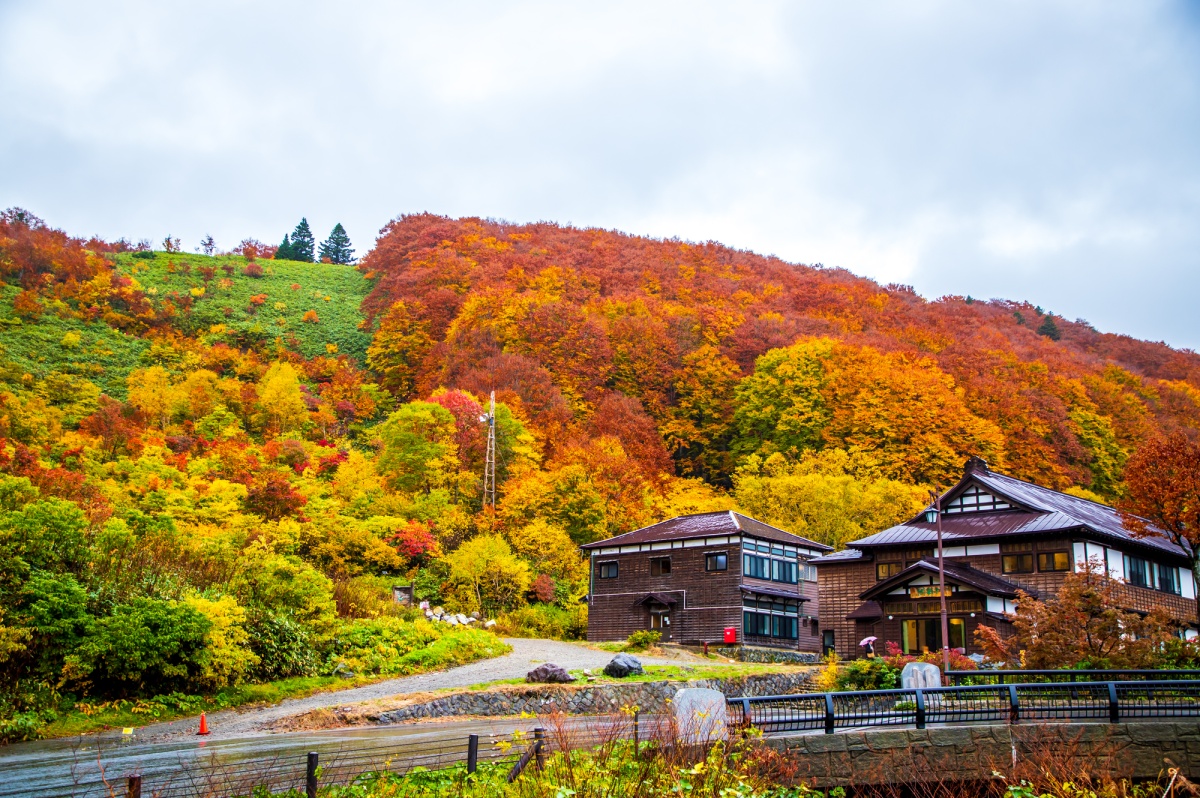
The Sukayu Hot Springs Resort is perched on a hillside and is probably the best place to acquire rapid “nudity immunity.” (pixta)
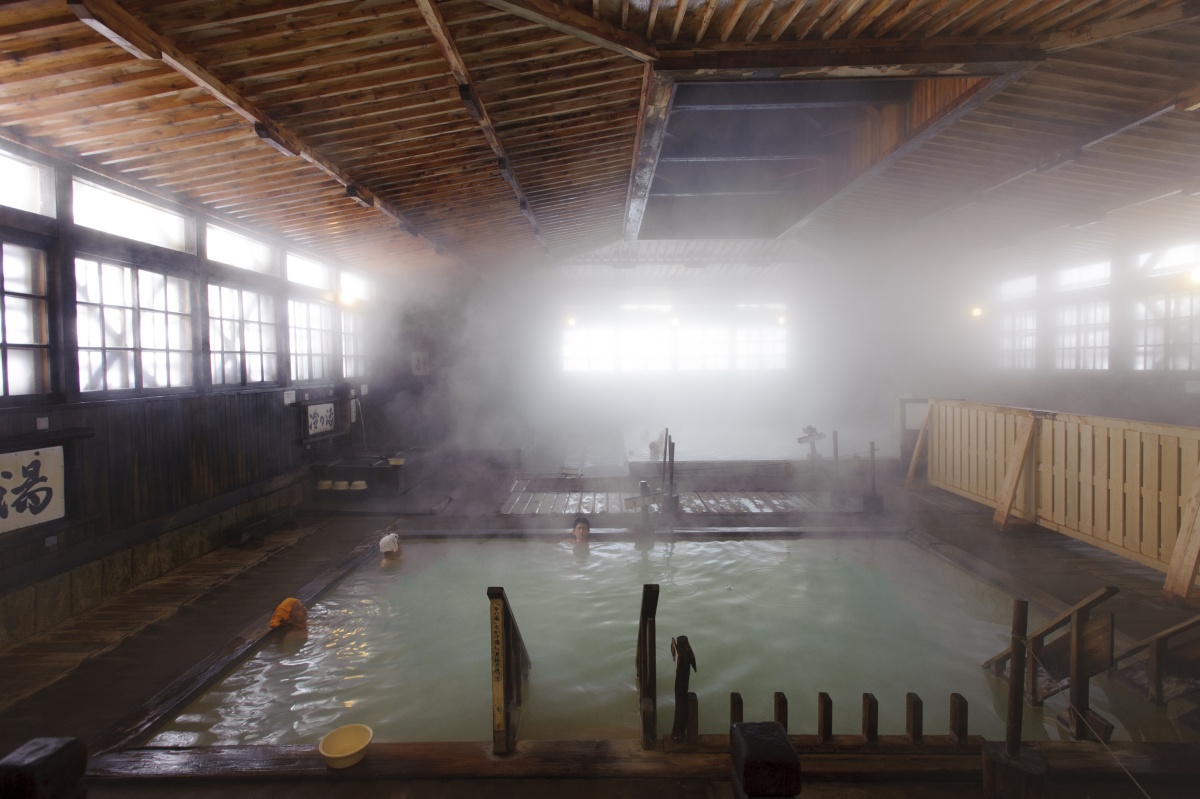
Sukayu Onsen’s evocatively named “Bath for a Thousand Bathers.”
Wild bathing among the fumaroles
Our next stop was Fukenoyu Onsen, which sits at the very top of the lower, southern section of the National Park. Nestled in a fold on the slopes of Mt. Hachimantai at an altitude of some 1,100 meters, Fukenoyu gets its name from the steaming fumaroles (fuke) around it. For over 350 years, Fukenoyu was a popular destination for the hot-spring therapy called ondoru. Literally hundreds of people at a time would lie down on straw mats in barrack-like wooden buildings to soak up the heat and the minerals into their bodies from the geothermally heated ground. But a 1973 landslide left only the main inn building intact, and the owners pivoted from a mass-market therapy model to offering a range of hot-spring baths to a more select clientele.
In line with this policy, Fukenoyu has so-called “wild” outdoor baths a couple of hundred yards away, across a stream and in the middle of the valley, in addition to indoor baths and more conventional outdoor baths in the immediate vicinity of the inn building. The main “wild bathing” complex features square baths (masuburo), bathtubs made from old miso barrels (taruburo) and a rock-lined bath with a loose pebble floor (iwaburo). A couple of weeks before we stayed, the proprietor had had to scoot down to the wild bathing area in his car to rescue the guests after a bear was spotted lumbering in their direction. Swimming with dolphins is all very well, but bathing with bears may be taking the whole wildness thing one step too far!
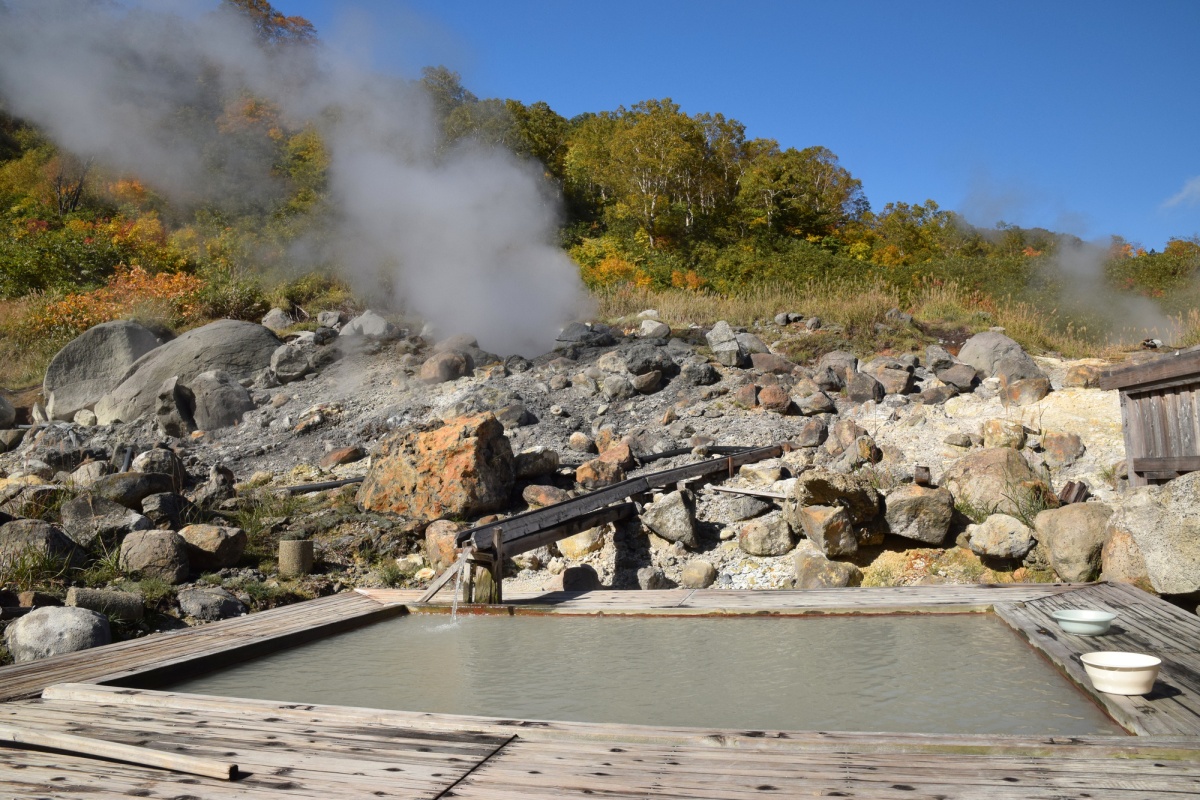
One of the open-air baths at Fuke-no-Yu, where “wild” bathing is the appeal.(pixta)
From Fukenoyu, it was only a short drive to Goshogake Nature Research Path, an otherworldly landscape of twisted pine trees emerging from the bleached, bilious and smoke-belching ground. Japan being otherwise such an orderly place, there was something refreshingly anarchic about the poorly socialized fumaroles which had blown holes in the path here and there, rendering them impassable.
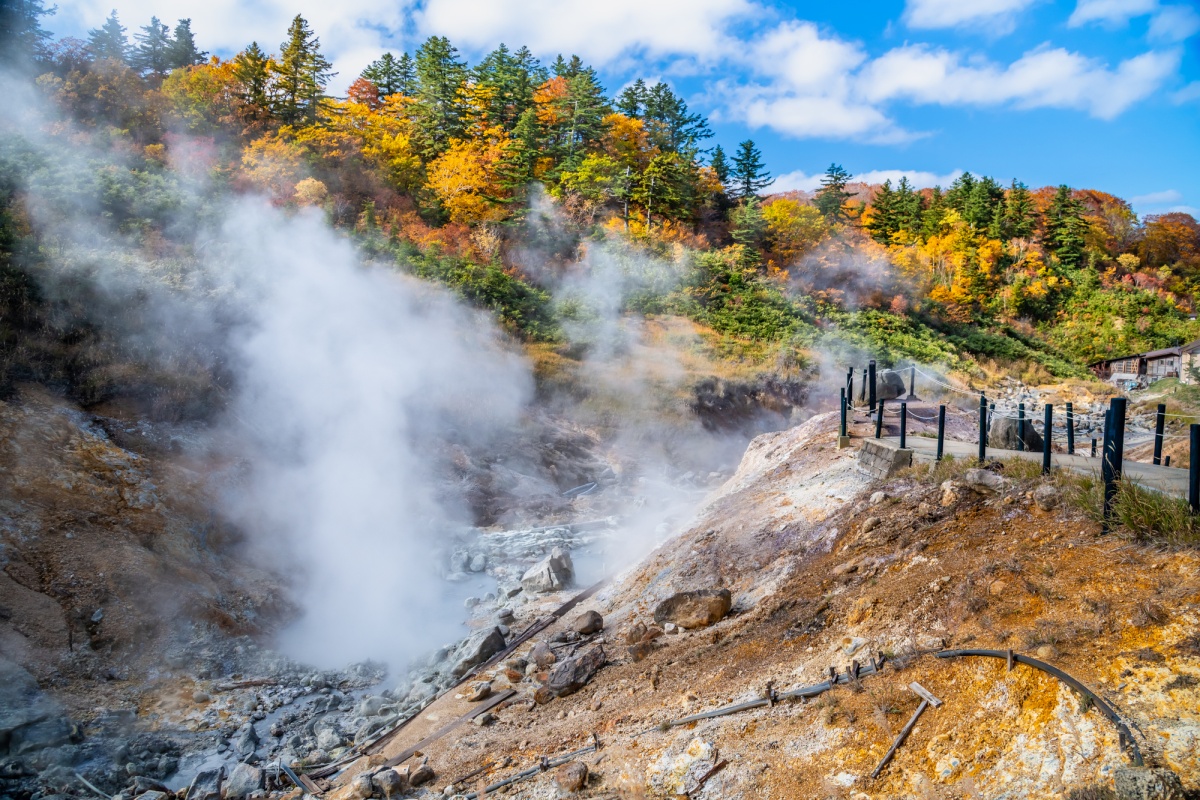
Goshogake Nature Research Path, an “otherworldly landscape of twisted pine trees emerging from the bleached, bilious and smoke-belching ground.”(pixta)
The summit of mixed bathing
Hot-spring mountain huts originally built for hikers and located near the summits of mountains are one of the national park’s distinctive features. After a brief stop at the cloud-wreathed 1,600-meter summit of Mt. Hachimantai, we dropped in to Toshichi Onsen Saiunso, an inn a couple of hundred meters below. Toshichi has a cluster of large mixed outdoor baths that blend naturally with the volcanic landscape of the mountain’s steaming, stony flanks. Getting to the baths involves walking down a boardwalk in full view of any passing car. But take courage! The lack of wrecks on the roadside suggests that motorists have better things to do than ogle the naked bathers. Nonetheless, paranoid patrons have the option of hiding their modesty with yuamigi wraps for women, and kilt-like garments for men, all of which are sewn by the proprietor himself during the winter months when the inn is closed and completely snowed under.
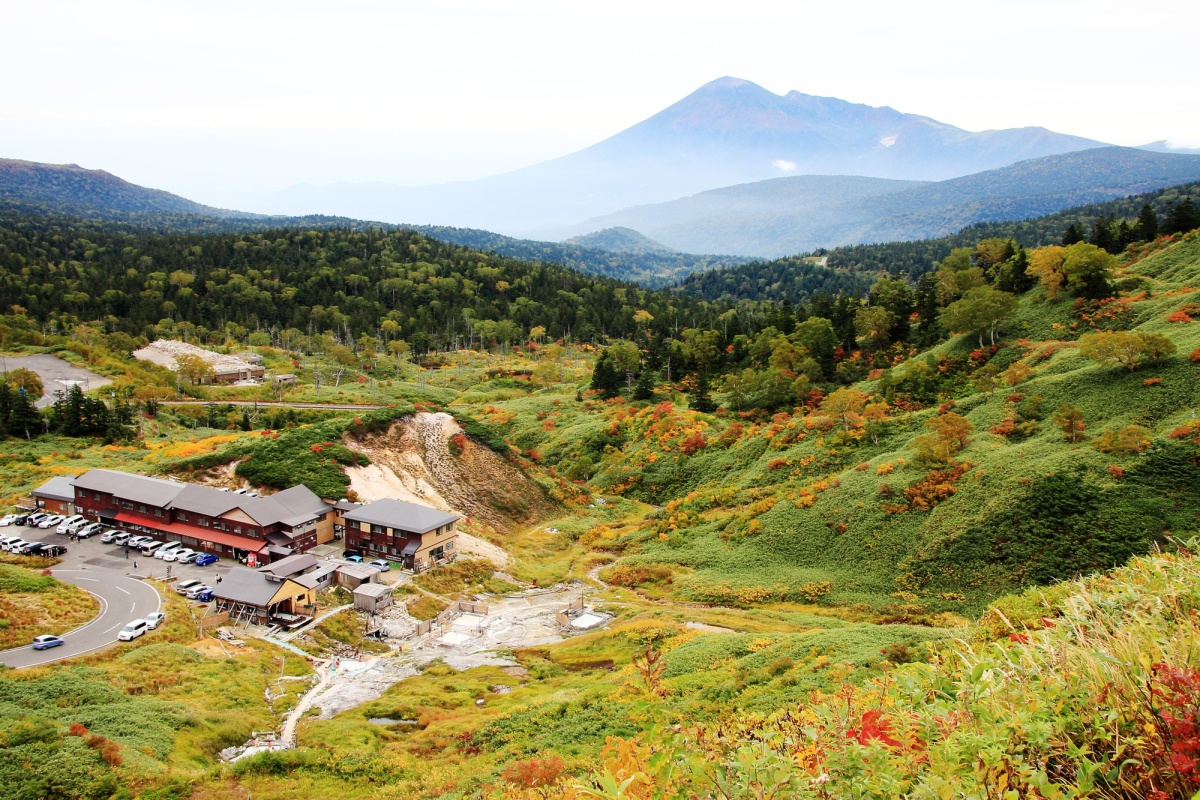
Toshichi Onsen Saiunso has a cluster of large mixed outdoor baths that blend naturally with the volcanic landscape of the mountain’s steaming, stony flanks. Mt. Iwate rises in the distance. (pixta)
Our next stop was a far less rough-and-ready proposition. Located at the southern end of the park, Tae no Yu only opened in the 1950s and was never really part of the tradition of catering to northeastern farming families. Instead, it consciously targets urban women—often the family members who decide where the family should go on holiday—with a sophisticated, Kyoto-inflected atmosphere and cuisine. Boutique in size, Tae no Yu is lit with Tiffany-style art nouveau lamps and the smell of incense wafts down the corridors. Although there are “family baths” for people who prefer their privacy, there is a mixed outdoor bath. As a matter of policy, female patrons are encouraged to drape themselves with a towel to avoid any issues with “crocodiles” (wani) as oglers are known in Japanese! (My wife and I agreed that a metaphorical crocodile was probably better than a real bear.)
A Bath Fit for a Lord
We had saved perhaps the most historic and atmospheric of all the hot spring inns in Towada-Hachimantai National Park for our last night. The origins of Tsuru no Yu date back to the mid-seventeenth century, when Satake Yoshitaka, the local feudal lord, began visiting the springs in an attempt to treat his gout. The inn’s aristocratic pedigree comes across in both the nomenclature and architecture of the buildings. The oldest and most distinctive of these is the honjin. A honjin is defined as an inn specifically for daimyo lords, nobles and shogunal officials and this guardhouse-like building was indeed built to house the local lord’s retainers in the last years of the shogunate. The exterior is long and low and the roof thatched, while the rooms have sunken irori hearths, and windows with shutters but no glass. It’s the perfect place for a weekend away in Edo-period Japan!
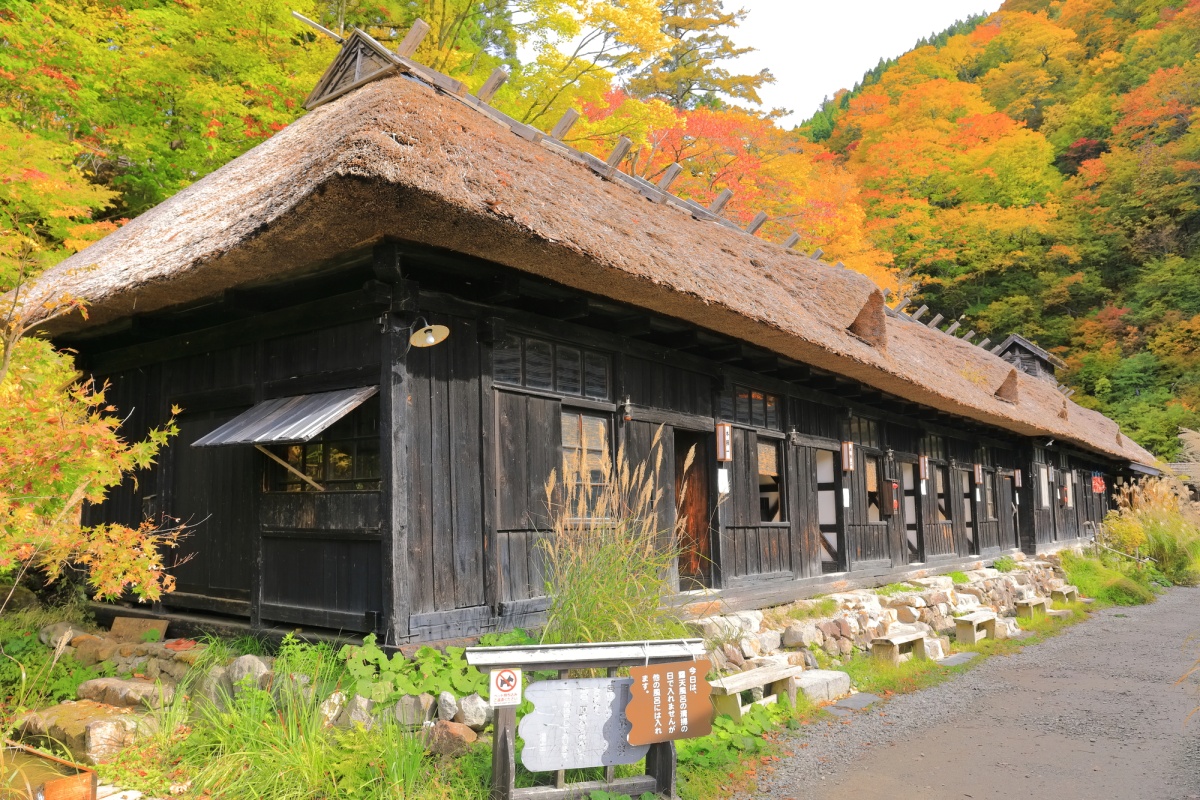
Tsurunoyu Onsen Honjin, a building to house the local lord’s retainers in the last years of the shogunate. (pixta)
The undoubted star of Tsuru no Yu’s eight baths is the large mixed outdoor bath, which is lined with boulders and merges into the forested hillside on one side. Thanks to a craftily designed entrance that uses sunken steps, tree trunks and a strategically placed rock, women can submerge themselves in the bath before they emerge into the bath proper. Fantastic at any time of year, Tsuru no Yu, with its dark wooden buildings and steaming, lake-like outdoor bath, is particularly atmospheric in the snow.
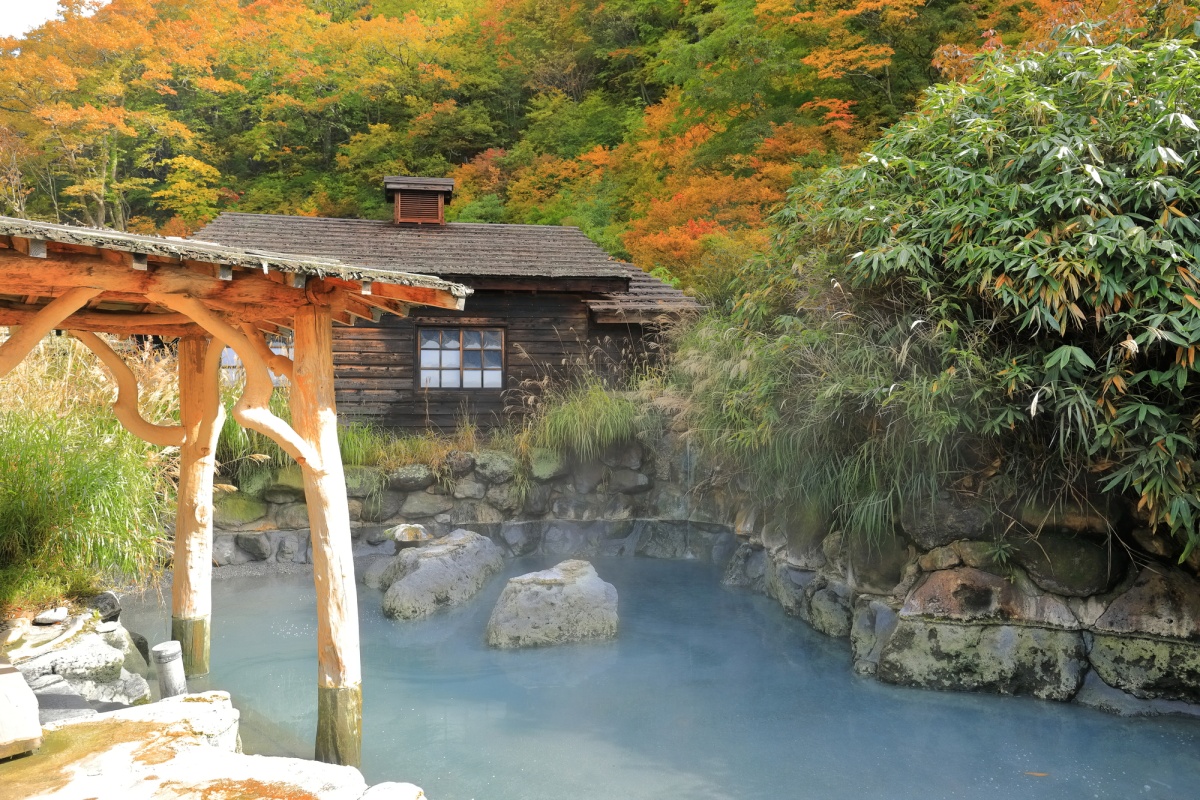
Tsuru-no-Yu Hot Springs is fantastic at any time of year, with its dark wooden buildings and steaming, lake-like outdoor bath. (pixta)
From Tsuru no Yu, it took us around half an hour to drive to the shinkansen station at Tazawako. Having returned our rental car, we settled into our seats and were whisked back to gymnophobic Tokyo, a distance of 500 kilometers and several centuries away.