

Getting Comfortable with the Elephant in the Room: Noboru Tsubaki at Towada Art Center
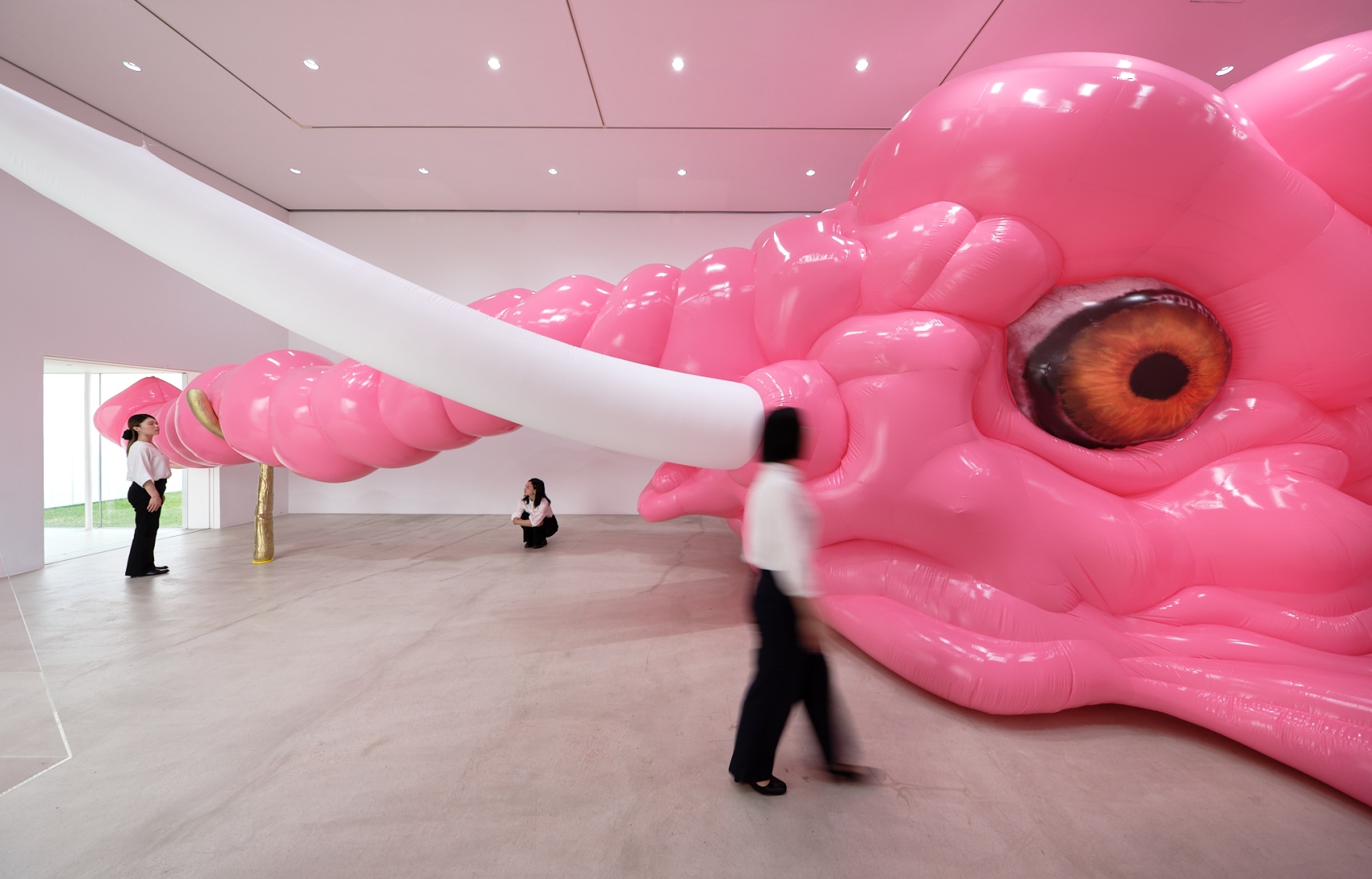
Noboru Tsubaki, the Elephant in the Room XL (2026). Photo: Kuniya Oyamada.
The lumpy head of a bright pink balloon elephant fills a room, its trunk stretching out the door. Facing it is a spinning wheel with thousands of opening and closing eyeballs. These are the creations of Noboru Tsubaki, a Japanese contemporary artist known since the 1980s for his massive sculptures that look at today’s world through a surreal lens.
By Jennifer PastoreTsubaki Noboru: FREEDOM––Living with “the Elephant in the Room” is a solo exhibition of new and site-specific works at Towada Art Center in Aomori Prefecture. Tsubaki (b. 1953) first grabbed international attention with Fresh Gasoline (1989), a tumor-shaped polyurethane sculpture in vivid yellow standing nearly 3 meters high and 3.6 meters long. The monstrous piece did more than catch eyes, it sparked discussion about humanity’s ecological impact and the conditions shaping life after the economic bubble of the eighties burst. Tsubaki has since exhibited across Japan, Asia, Europe, and the Americas.
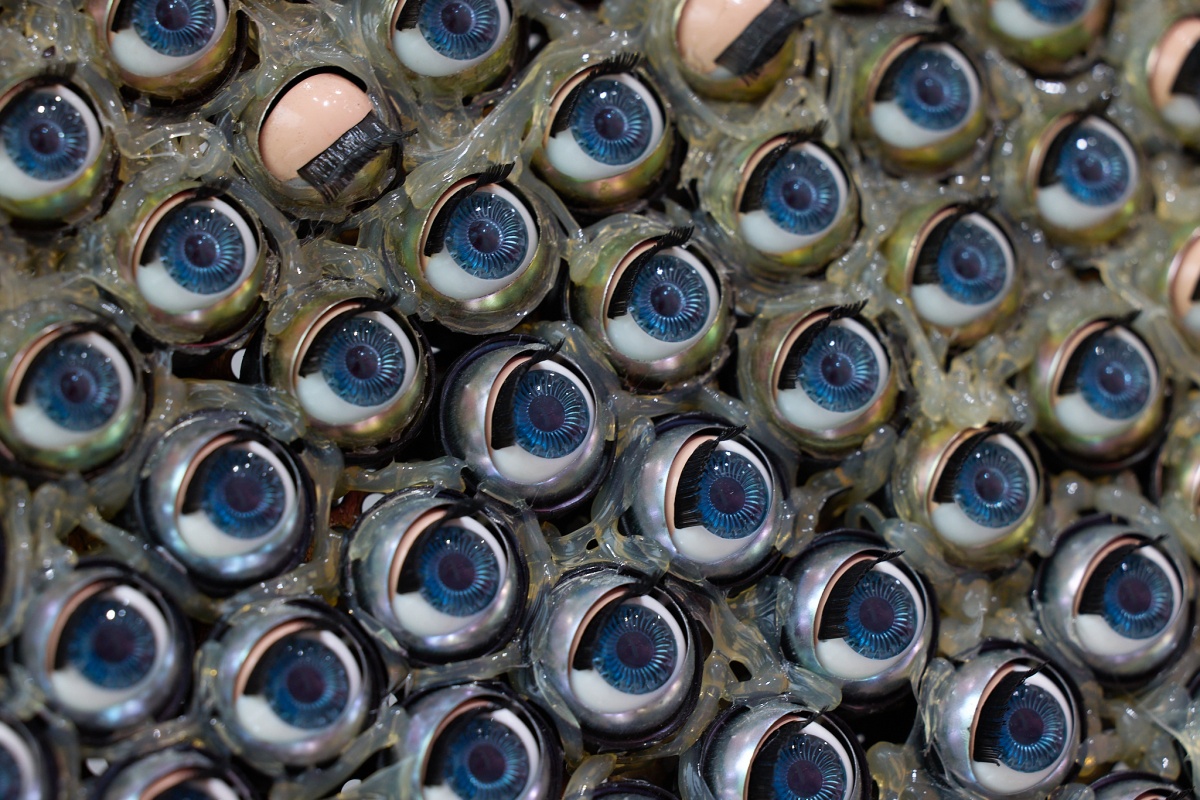
metapolice (1999), an earlier work made up of 7,000 eyeballs that slowly blink as the wheel they are inserted into turns. These sculptures question what we as a society see and choose not to and how surveillance has crept into our lives. Photo: Kuniya Oyamada.
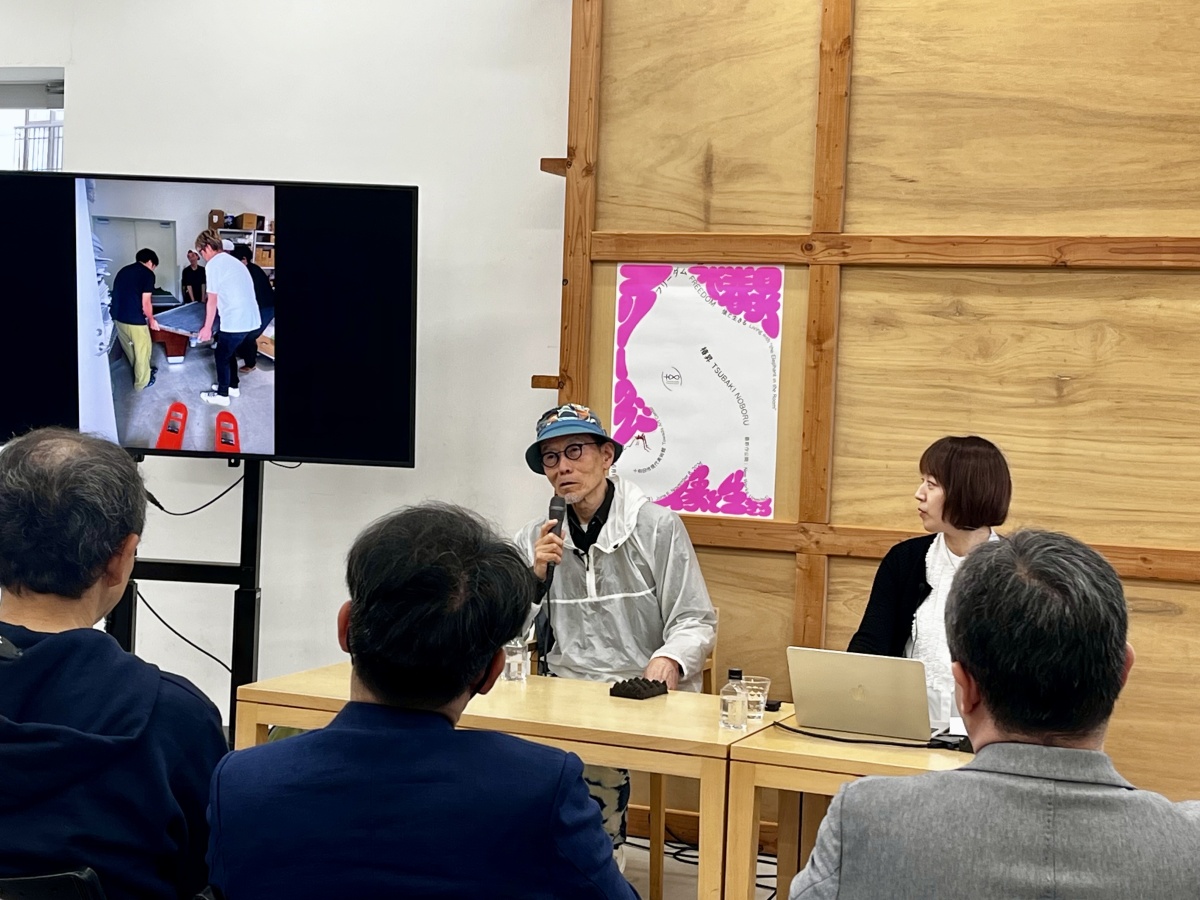
Tsubaki (left) gave a public talk about his work with Towada Art Center’s Chief Curator Eriko Nagao (right) at the museum on the show’s opening day, June 6, 2026. Photo: Jennifer Pastore.
Ants, Elephants, and Trojan Horses
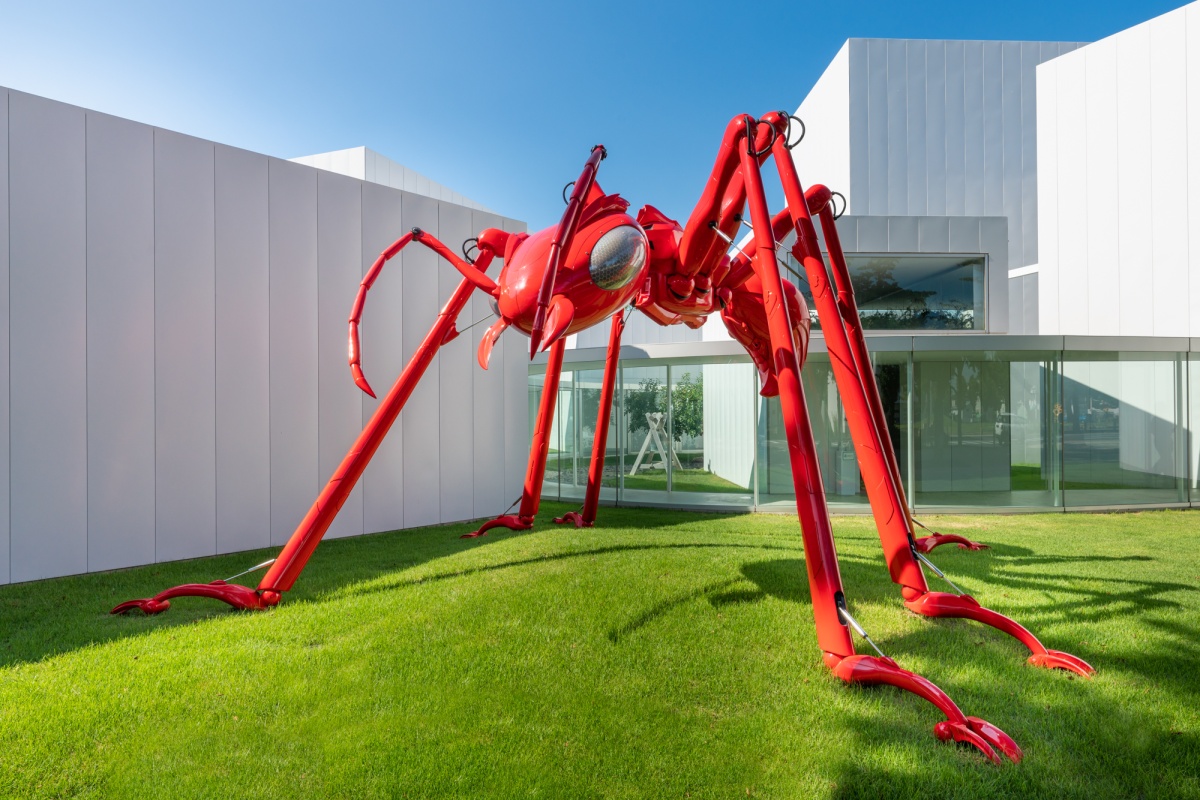
aTTA (2008) at Towada Art Center. The six-meter-tall robot ant, which can be seen outdoors year-round, is the only work by Tsubaki held in the permanent collection of a Japanese museum. Photo: Kuniya Oyamada.
aTTA (2008), a towering bright-red robot insect modeled after the Central American leafcutter ant, is permanently displayed on the museum’s front lawn. Tsubaki comes up with his artistic concepts independently, then works with factories and teams of people to realize them in a collaborative, non-linear process.
In an interview with All About Japan at the opening for his new exhibition, he said: “There’s something about the sheer size of large works that really moves people. There’s this ‘Wow!’ factor. Giant icons have the power to go beyond their assigned meanings and historical contexts. My works are all Trojan horses, in a sense. They may seem deceptively simple, but they have deeper political meanings.”
Among the more complex themes explored in the show are issues people avoid confronting (i.e., “elephants in the room”) and restrictions on personal freedom in our image-inundated modern society. Addressing a world in which people feel surveilled while bigger issues go ignored, the artworks––sculptures, installations, photographs, and paintings––blur the line between conceptual and popular art. The show’s title is rooted in a Japanese play on words: the characters for 象 (elephant = zo ) and 像 (image = zo ) look very similar.
A Map of the Mind
Four linked sections make ingenious use of the Towada Art Center’s architecture to convey Tsubaki’s worldview. The first, “The zo in the Room,” occupies a white cube space on the ground floor, with natural light streaming in through a wall-sized window. Here, the Elephant in the Room XL (2026), and the wheel of eyeballs, metapolice (1999), speak to our tendency to look away from what we would rather not see––even when it looms conspicuously and comically large––and to our sense of being constantly watched in this age of news, social media, and endless image consumption. We cannot hide, even as we pretend not to see.
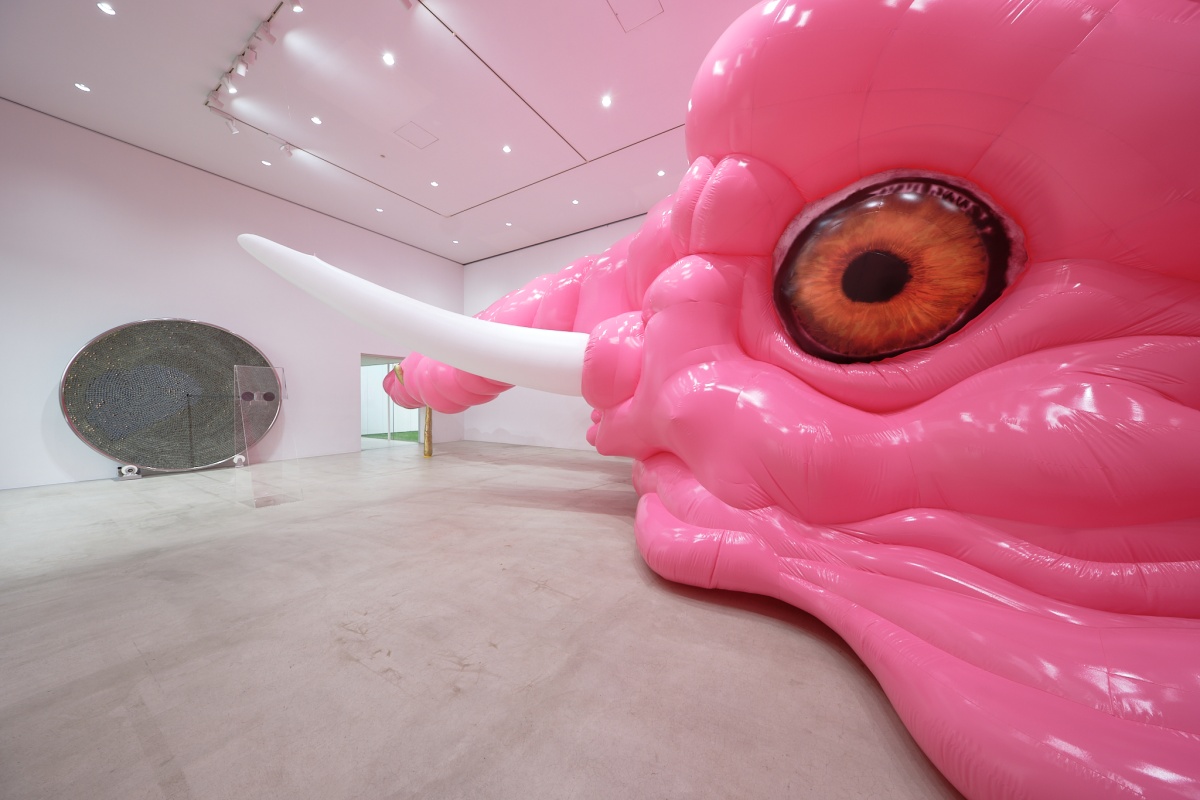
Installation view from Tsubaki Noboru: FREEDOM—Living with "the Elephant in the Room", 2026. Tsubaki has been creating large-scale balloon sculptures since he debuted a giant inflatable grasshopper at the 2001 Yokohama Triennale. Photo: Kuniya Oyamada.
When asked what he considers to be today’s “elephants in the room,” Tsubaki named issues including war, AI, and a loss of purpose in education. “We’re seeing a breakdown in education’s role as a stabilizer between the individual and society. It’s become an engine of propaganda––a bulk processing facility that stifles individual creativity. This can put people on the path to war, like we’ve seen with Russia.”
These concerns aren’t just abstract ideas––they frame the entire structure of the exhibition. The second section, a long corridor titled “Extent of contact between society and individual,” considers how a person can engage with the world while living alongside these thorny realities. The walls are lined with the artist’s soft-focused pastel photographs of flowers, a series called Under the Rose (2026).
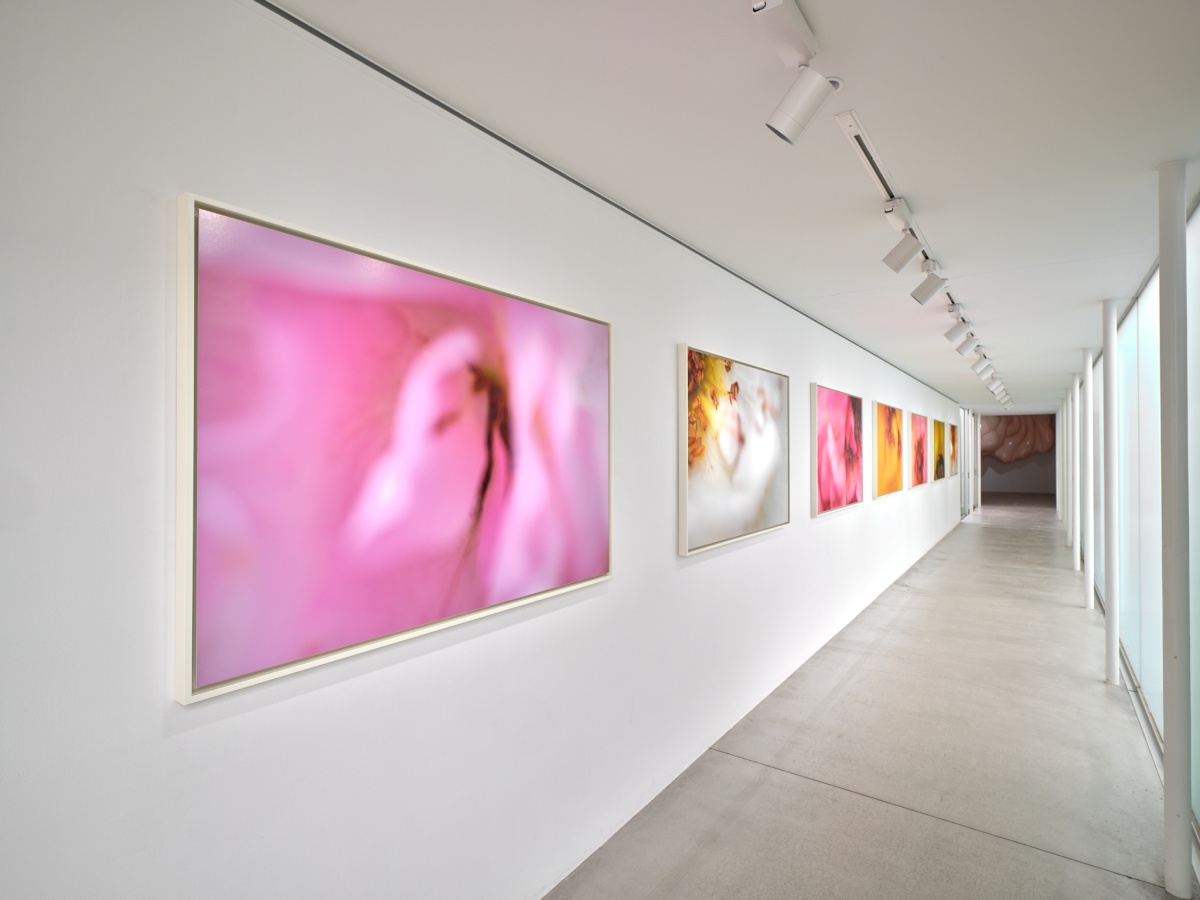
Under the Rose (2026). The exhibition’s second section is a long corridor with framed prints from Tsubaki’s floral photography series. Photo: Kuniya Oyamada.
The exhibition text notes that the word “rose” evokes love, beauty, and desire, and suggests that personal desires, expressed too clearly and directly, risk threatening the existing order and inviting rejection by society. “Perhaps it is best for personal desires to remain somewhat ‘out of focus,’ much like these photographs.” Tsubaki’s solution, it seems, is to learn to live in harmony with the “elephant,” rather than ignoring it or trying to eliminate it.
To the right of the hallway is “Inside the mind of Tsubaki Noboru.” The artist spent two weeks living in this den-like room before the show’s opening, constructing it through what the exhibition describes as “the accumulation of his own ruminations.” The result is one large mixed-media installation, called The Order of Time (2026): It is filled with an armchair, a billiard table, books, DVDs, and works from his four-decade career. Among them is a painting from his student days, created as an homage to Surrealist masters, along with miniature models for his elephant sculpture and Fresh Gasoline.
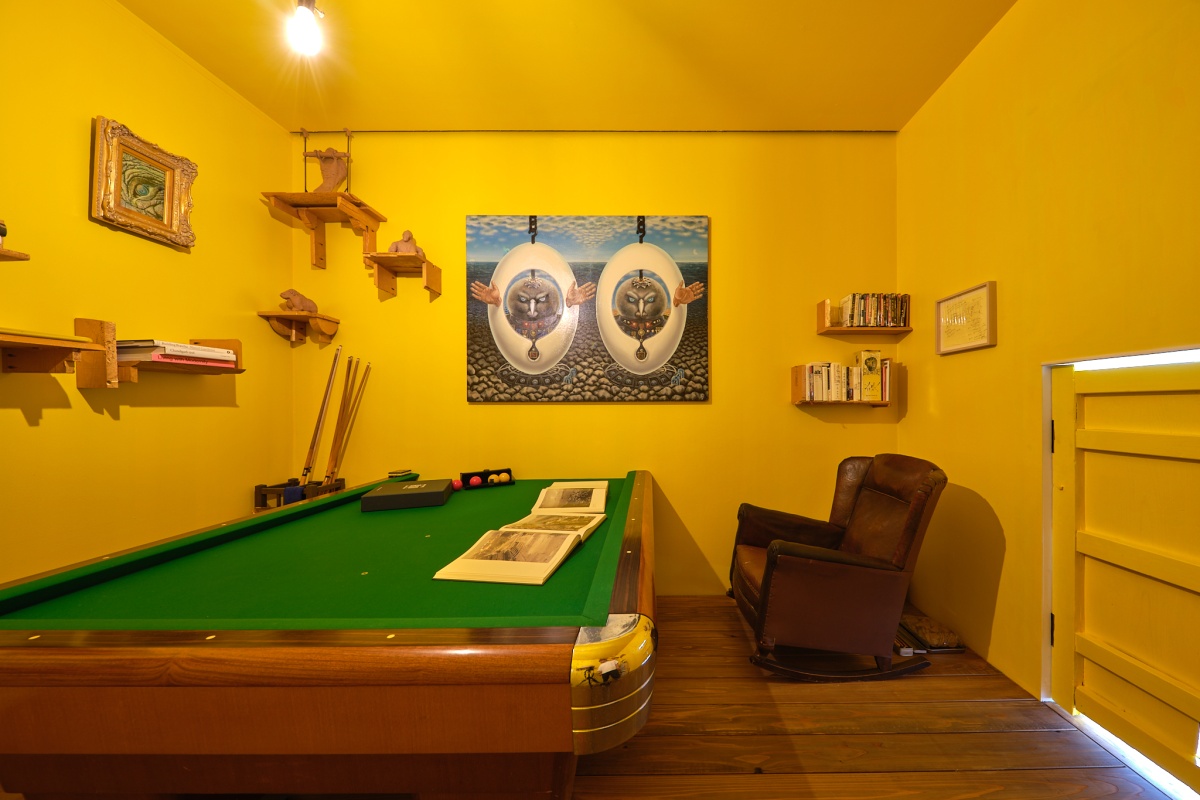
The Order of Time, 2026. Visitors can step into a cozy room embodying the artist’s mind, filled with his artworks, favorite possessions, and his creative influences. Photo: Kuniya Oyamada.
The Search for Meaning
The final room, linked to the first by the corridor, explores the relationship between taboos and freedom in “Where society and the individual meet.” It houses two works: the Elephant in the Room M (2026), a wall-mounted balloon elephant head with an inflated trunk that connects to 1•2•3•4•5•6•7•8•9•10 (2026), a psychedelic acrylic painting depicting Friedrich Nietzsche, Vincent van Gogh, Salvador Dalí, and Giorgio de Chirico––all influences on Tsubaki. The word “FREEDOM” headlines the piece, painted by hand using images generated in conversation with an AI program.
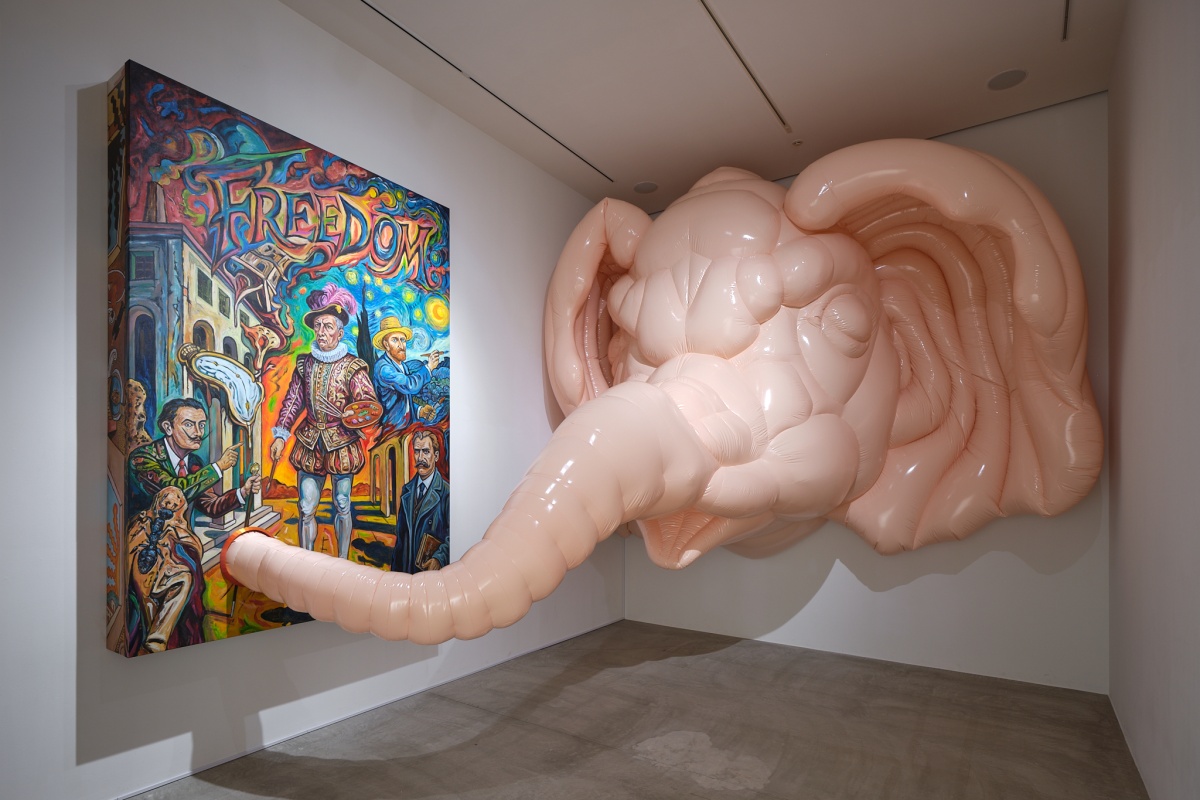
Installation view from Tsubaki Noboru: FREEDOM—Living with "the Elephant in the Room", 2026. The final section displays a second “elephant in the room” and a painting created as a collaboration between the artist and AI. Photo: Kuniya Oyamada.
Tsubaki sees this age of AI as part of a broader human search for meaning. “People look for meaning through things like working for big companies or going to “good schools”––this is true all over the world––but there will always be ‘bugs’ in the system,” he said. “We get fired, we get into accidents, we get sick. The things that give us ‘meaning’ are not in themselves stable or guaranteed, but society today is absolutely not producing people who can accept this reality or live with it as a premise… Artists should be the ones resisting this system, but instead they’re too swayed by financial markets. Art has lost its original meaning and been absorbed by the world of money. It’s lost its magic.”
His outlook is not entirely pessimistic, however. He sees hope for the future, as long as people continue in their search for significance while learning to engage with what makes them uncomfortable. As he explains in the exhibition text, today’s world requires the coexistence of the digital and the physical, which means finding a balance between artificial systems and their “bugs”––meaning our own individuality and creative expressions. “Connecting these two polar opposites is the key to living freely in this society,” he says.
Art on the Town
Besides the museum, Tsubaki’s works can be seen at two local shops during the exhibition period. The bookstore Tsundoku Books presents drawings for aTTA (2007) robot ant sculpture. Matsumoto Chaho, a green tea, pottery, and antique shop established in 1908, is displaying a maquette for aTTA (2007) among its wares.
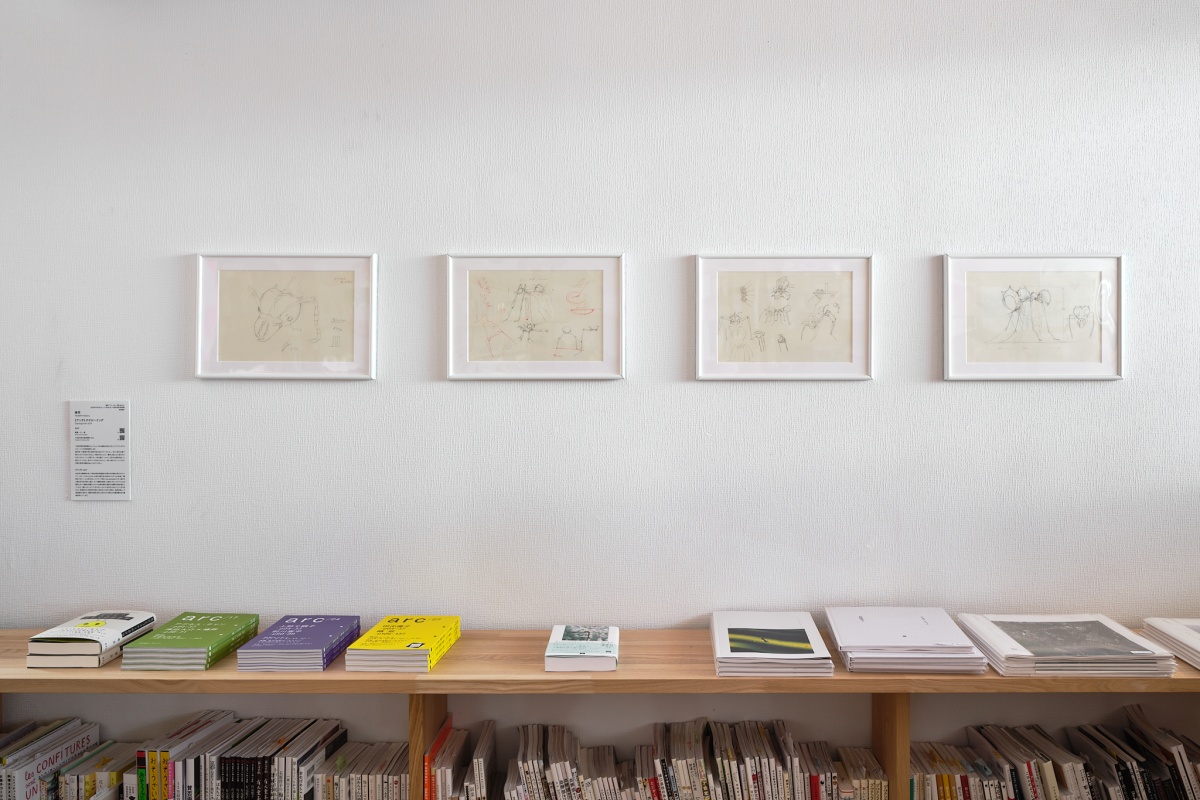
Drawings for aTTA (2007) are displayed at Tsundoku Books in Towada, Aomori.
Photo: Kuniya Oyamada
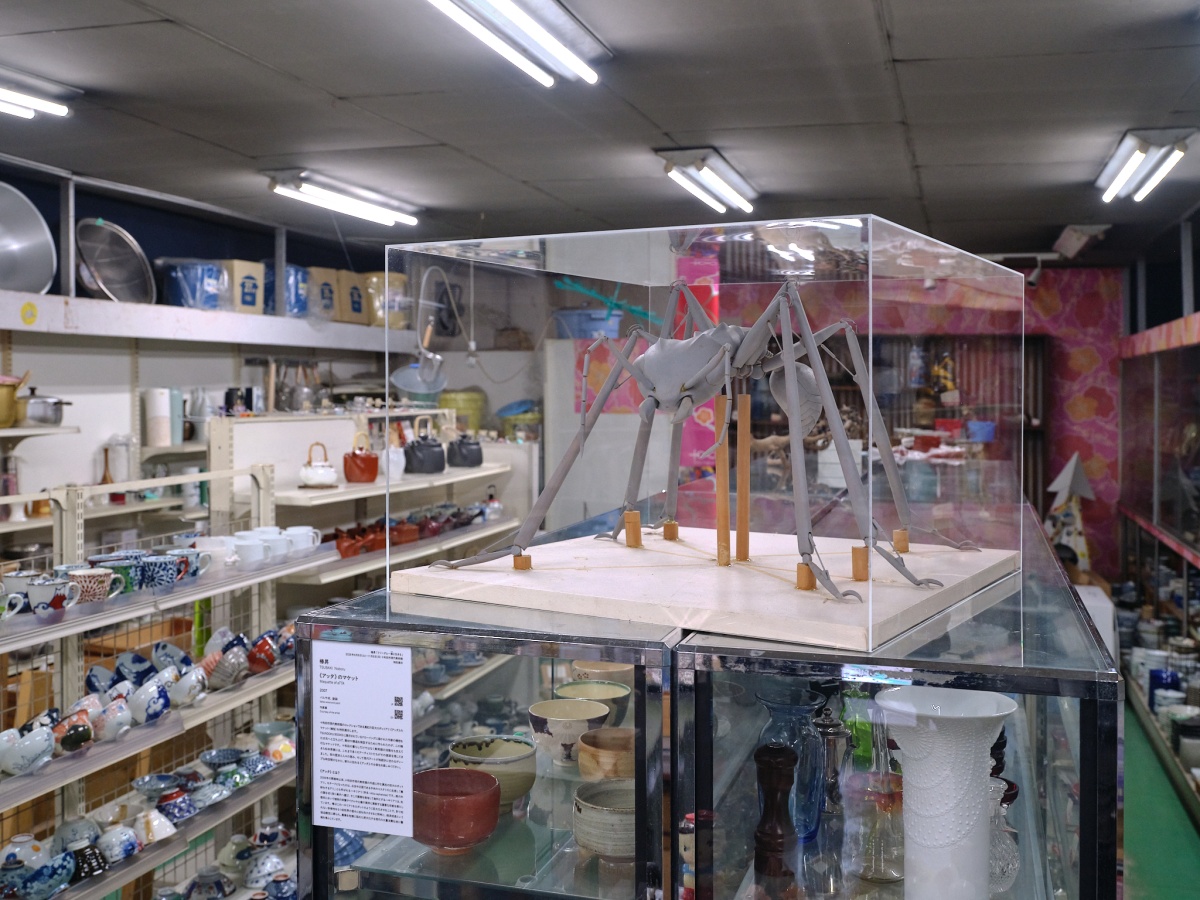
Maquette for aTTA (2007) is shown at Matsumoto Chaho, a matcha and antique shop with its own unique collection of contemporary art, also within walking distance of Towada Art Center. Photo: Kuniya Oyamada
Towada Art Center opened in 2008 with the aim of helping to revitalize a small historic city in northern Japan through contemporary art. The museum’s special exhibitions and its permanent collection are accessible and engaging for all ages and backgrounds.
The facility, designed by Pritzker Prize-winning architect Ryue Nishizawa, is made up of independent “houses for art” connected by glass corridors. The rooms showcase the permanent collection of 42 commissioned artworks by 37 Japanese and international artists, including Yayoi Kusama, Yoshitomo Nara, Leandro Erlich, and Ron Mueck. Many of the white-cube spaces are custom-built for the artworks, with large windows making the pieces viewable from outside. The on-site cube cafe & shop is a bright, colorful space offering light meals and snacks inspired by the exhibited artworks, as well as a selection of art books and museum merchandise.
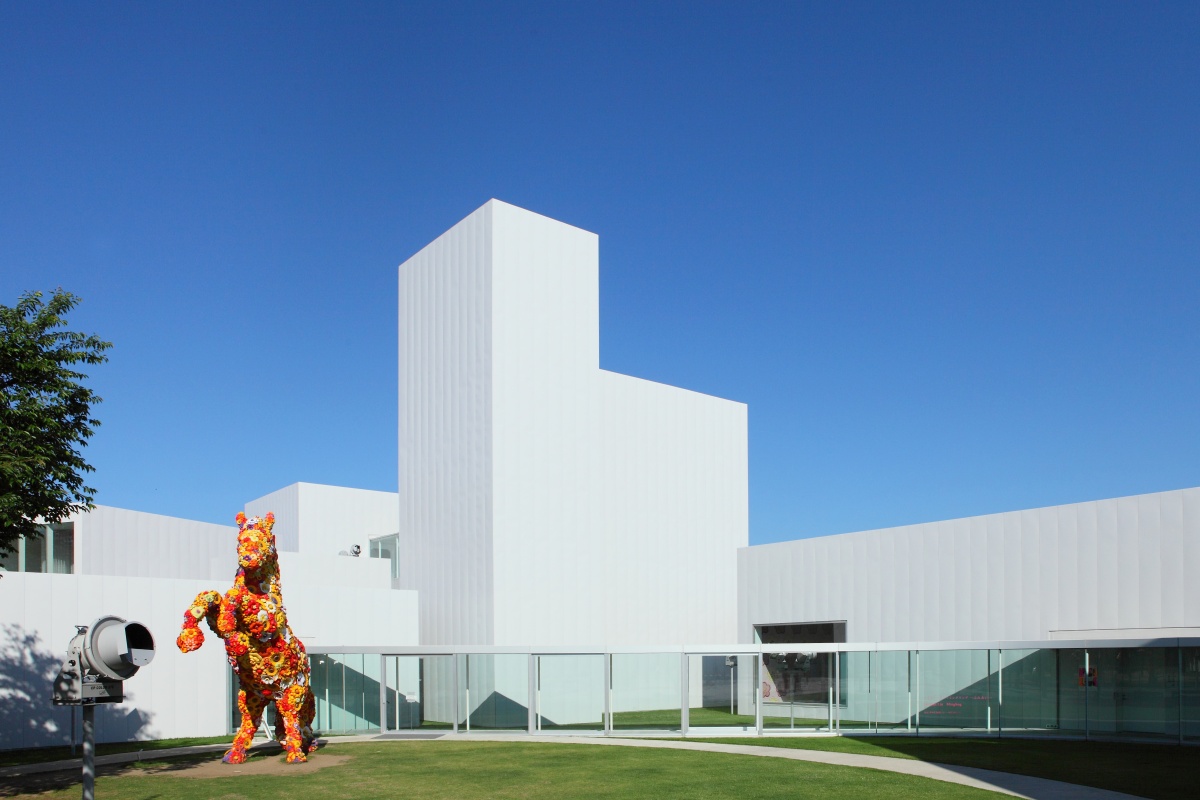
Exterior view of Towada Art Center. The city of Towada was once known for its military horses. The museum’s outdoor collection includes “Flower Horse” (2008) by the Korean artist Jeonghwa Choi. Photo courtesy of Towada Art Center.
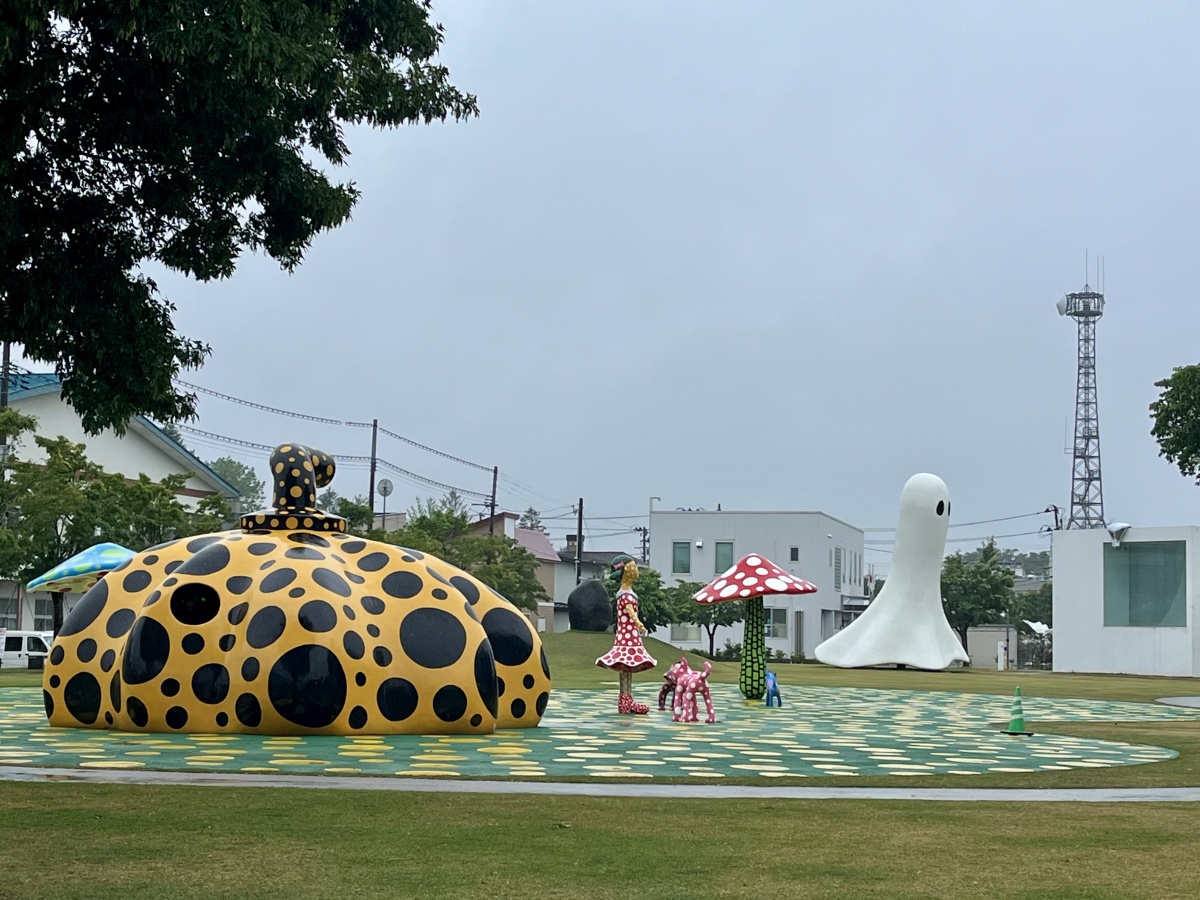
Love Forever, Singing in Towada (2010) ©YAYOI KUSAMA is a collection of polka-dotted sculptures by Yayoi Kusama, including the Japanese artist’s celebrated pumpkins. This installation and others, including Ghost & Unknown Mass (2010) by the German art collective inges idee, are located opposite the museum at the Art Square. They can be viewed throughout the year. Photo: Jennifer Pastore
Reproduction of this image is prohibited.
Across the street, Art Square offers a playground-like collection of large, immersive outdoor sculptures. More public installations–including artist-designed benches–are found around the city.
DATA
Tsubaki Noboru: FREEDOM––Living with “the Elephant in the Room”
Dates: June 6 (Sat) – November 8 (Sun)
Venue: Towada Art Center (10-9 Nishi-Nibancho, Towada-shi, Aomori)
Hours: 9:00–17:00 (admission until 30 minutes before closing)
Closed: Mondays (except for National Holidays, in which case the museum is open on the holiday and closed the following Tuesday). Open on August 3 (Mon) and August 10 (Mon).
Admission: General ¥1,800 (including the permanent collection). Under 18: Free.
Website: https://towadaartcenter.com/en/exhibitions/tsubaki-noboru-freedom/
Jennifer Pastore has been an enthusiastic chronicler of Japanese art and culture since around 2013. An Indiana-born, Tokyo-based journalist and translator, she writes for a variety of Japanese and international publications while assisting with the AIR 3331 artists' residency program.
https://residence.3331.jp/en/
