

The Porcelain Legacy of Arita’s Kilns
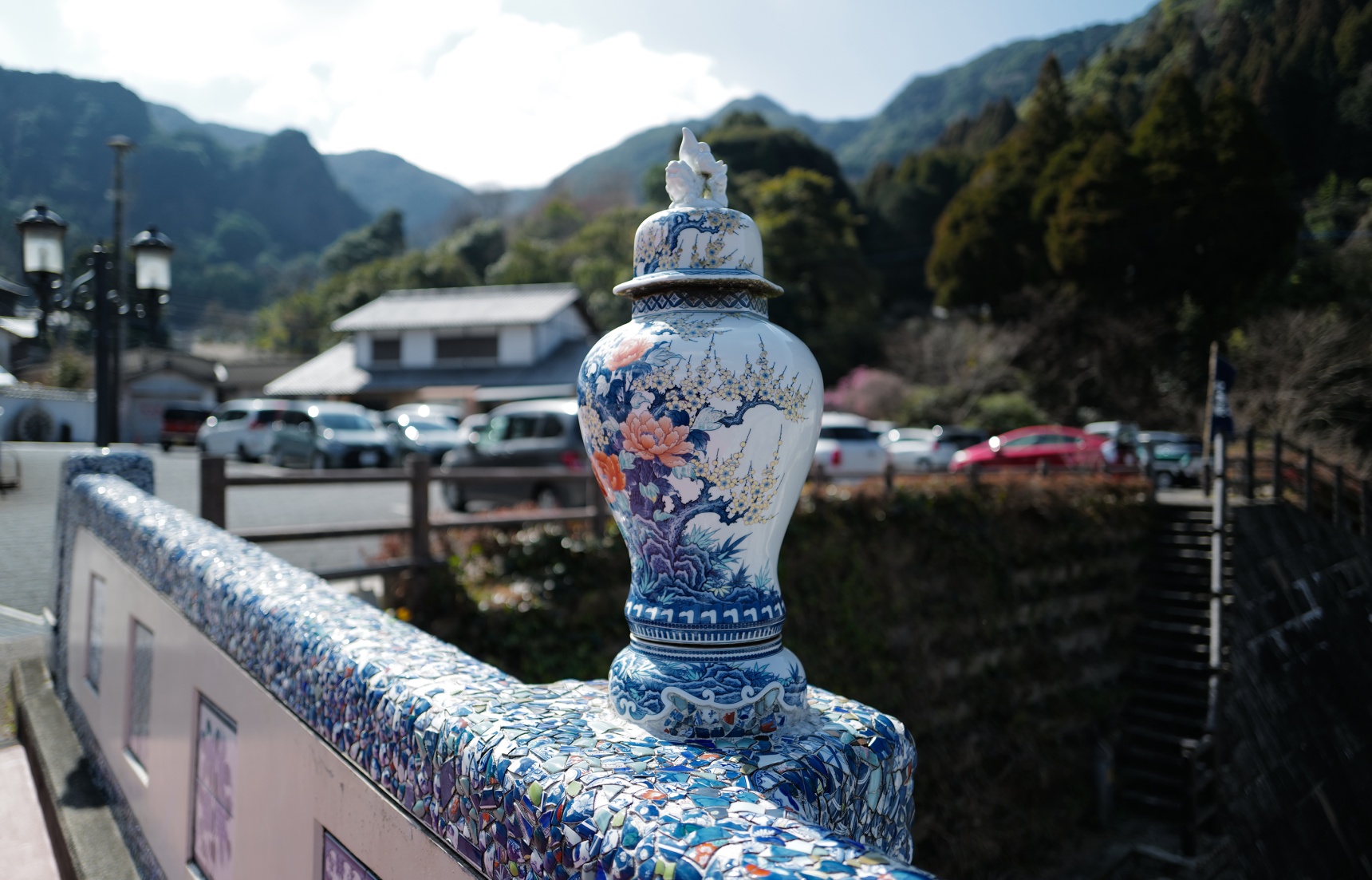
A Nabeshima-ware vase on the bridge at the entrance to Okawachiyama, the “Village of the Secret Kilns.” Photo: Andrew Lee
Japan's porcelain industry was kickstarted by events that shook the country 400 years ago. Andrew Lee visited Saga Prefecture and discovered the history of the region's ceramics.
By Andrew LeeAs I make my way down the path at Izumiyama quarry in Arita, Saga Prefecture, I notice the paving stones embedded with tiny shards of broken pottery. Each blue-and-white fragment is different, some decorated with delicate patterns of flowers or leaves, and I find myself wondering what they once were. Maybe a bowl, a plate, a vase? Something expensive, or cheap? Perhaps the clay used to make them came from this very quarry, which was designated as a national historic landmark in 1980.
It was here at Izumiyama, in 1616, that a Korean potter named Yi Sam-pyeong is credited with discovering kaolin, the soft white stone essential to porcelain production. His discovery marked the beginning of Japan’s porcelain industry, and kilns soon multiplied nearby. For more than two centuries the stone here was quarried by hand, and local lore says the whole mountain was transformed into ceramics.
Today the quarry is silent. All that remains are some pale stone cliffs topped with trees, around a crater where that mountain once stood. Nearby, a ceramic monument marks 400 years of porcelain production. On a photo of the quarry operation in 1929, rendered in blue and white tiles, much of the mountain seems to have already vanished. But by then, porcelain had been made from Izumiyama stone for almost three centuries, and Arita ware had made it as far as the royal courts of Europe.
War, Trade, and the Birth of an Industry
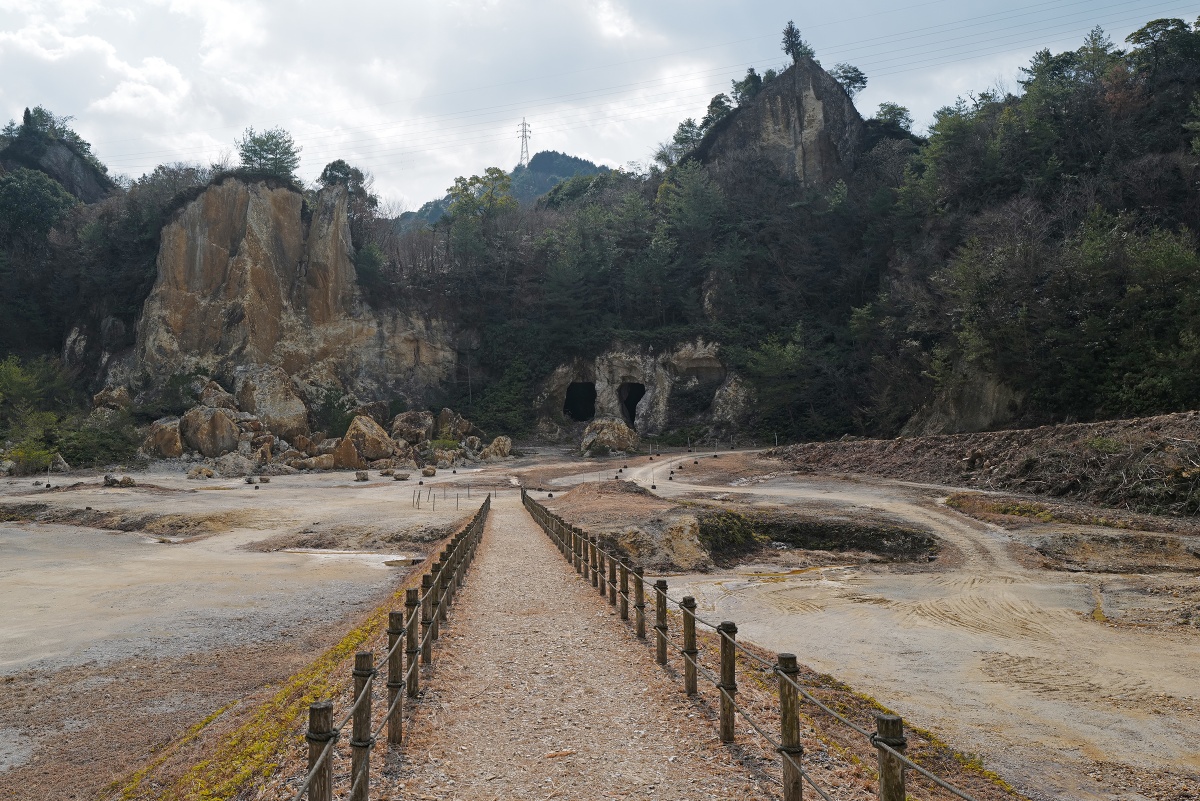
Izumiyama quarry, the birthplace of Japan's porcelain industry. Photo: Andrew Lee
What is remarkable is that the original demand for Saga’s porcelain occurred during Japan’s isolationist sakoku (closed country) era—which began in the 1630s and lasted until the 1850s. As I was to learn, however, it was precisely the restrictions of sakoku that created the conditions in which Japanese porcelain could flourish.
The story of porcelain in the area began in the 1590s, when the feudal lord Toyotomi Hideyoshi invaded Korea with a coalition of Japanese domain lords known as daimyo. Among them was Nabeshima Naoshige, who controlled the Saga Domain in Hizen Province, an area that encompassed most of modern-day Saga and Nagasaki Prefectures. Acting on Hideyoshi’s orders to seize craftspeople and other skilled workers, Nabeshima brought several talented Korean potters back to his Kyushu home. Among them was the aforementioned Yi, who was to discover the porcelain stone at Izumiyama.
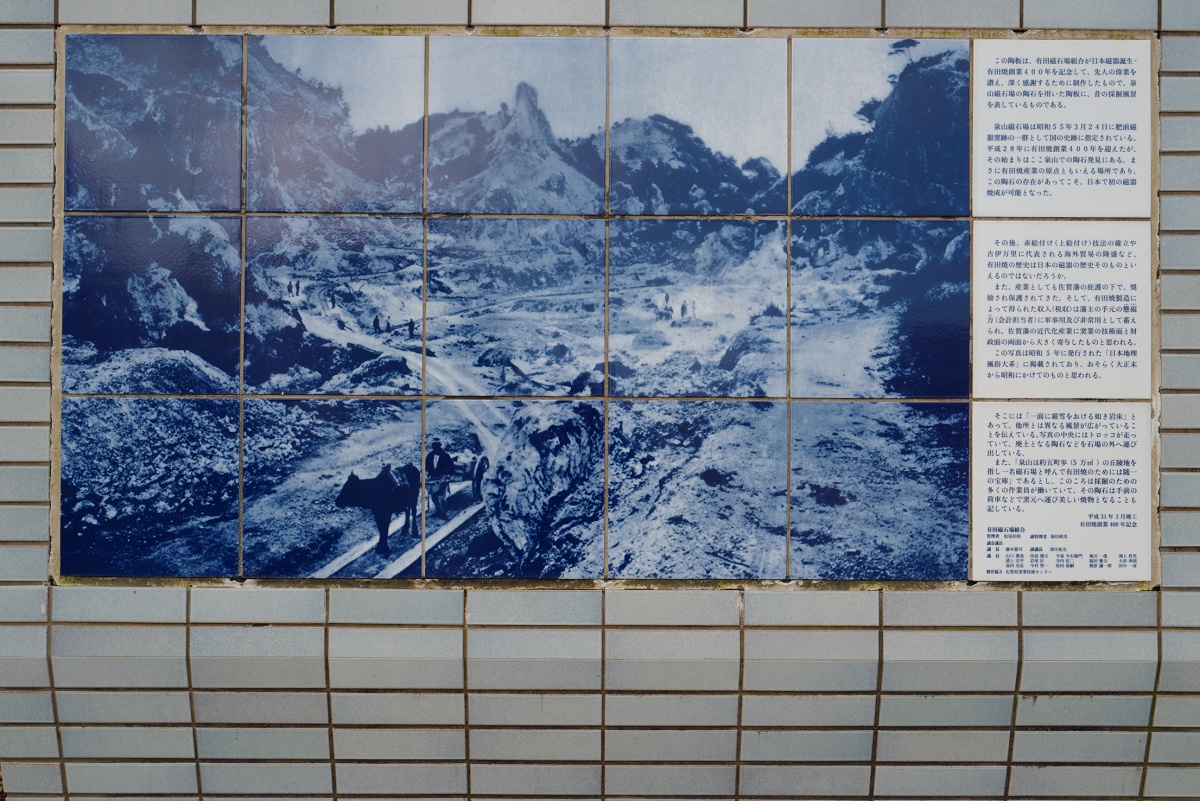
A monument at Izumiyama commemorating the 400th anniversary of the birth of Japan's porcelain industry. The photo depicts the quarry in 1929. Photo: Andrew Lee
After Toyotomi’s death in 1598, Tokugawa Ieyasu seized power and established his military government in Edo. As the shogunate consolidated its power, it began to reassess Japan’s foreign ties. The Portuguese had been in Japan for decades, but their links to Catholic missionary activity, which the shogunate saw as a threat, made them increasingly unwelcome.
When the Dutch ship De Liefde washed ashore in Kyushu in 1600, its English pilot, William Adams, became a trusted adviser to Tokugawa. A sworn enemy of the Spanish and Portuguese, he helped secure trading rights for the Dutch East India Company (VOC), and established a trading post on Hirado island, off the coast of Nagasaki, in 1609. Foreign trade was later tightened even further: the Portuguese were expelled in 1639, and the Dutch were moved to Dejima, a small artificial island in Nagasaki harbor, in 1641.
From Chinese Disruption to Japanese Innovation
The international ceramics market at the time was dominated by porcelain from the Jingdezhen kilns in China. But the disruption in production by the unrest of the Ming–Qing transition had direct consequences in Saga. The local Nabeshima clan had long relied on gifts of prized Chinese porcelain to maintain favor with the Tokugawa shogunate. When the supply of Jingdezhen ware became unreliable, the domain turned to its own kilns in Arita.
The Dutch saw it as an opportunity. Having long shipped “china” to Europe, they now redirected demand toward Japan’s fledgling porcelain industry. What followed was a two-track system that would shape ceramic production in Saga for generations. One track saw secretive domain kilns serving the political needs of the Nabeshima clan; the other consisted of commercial kilns feeding European demand through the VOC.
Around 1647, a potter named Sakaida Kizaemon, working with a local Imari merchant, developed Japan’s first polychrome overglaze enamel porcelain. The breakthrough transformed the mainly blue-and-white style known as ko-imari into richly colored ware influenced by Chinese techniques. (Sakaida would later take the name Kakiemon I.)
From the late 1650s, ceramics from Arita were carried downriver to the port of Imari, and from there by sea to Nagasaki, where they were transferred to VOC ships at Dejima for export to Europe. There they became known simply as “Imari ware,” and proved immensely popular.
Imari Goes Global
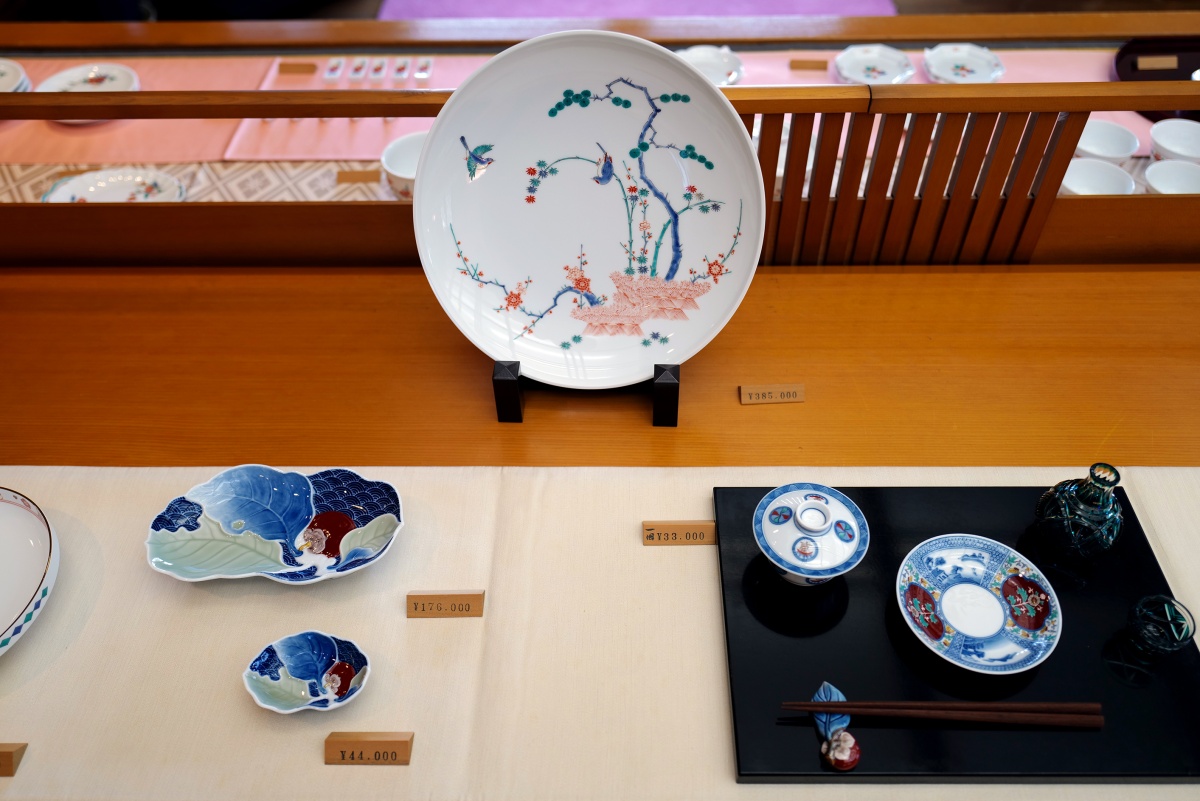
Kakiemon porcelain is prized for its milky white nigoshide bodies and bright akae overglaze enamel with asymmetrical designs of birds and flowers.
The VOC commissioned Arita kilns, including Kakiemon, to produce vessels more suited to European life—such as tankards, bottles and teapots—adapting Japanese porcelain to Western taste and driving demand still further. Kakiemon ware became the most celebrated of the export styles. With its asymmetrical designs of birds and flowers, it stood apart for its milky white nigoshide bodies and bright akae overglaze enamel, and was highly prized by the European aristocracy.
Unfortunately, they became so sought after that European kilns later copied them extensively—most notably Meissen in Germany, which was founded in 1710 in part to unlock the secrets of Japanese porcelain. By the mid-1700s the demand for authentic Imari-ware had dropped, but the kilns in Arita kept firing.
Today, several of those original kilns still produce porcelain in Arita. Including Kakiemon, now headed by Kakiemon XV.
Inside the Kakiemon Kiln
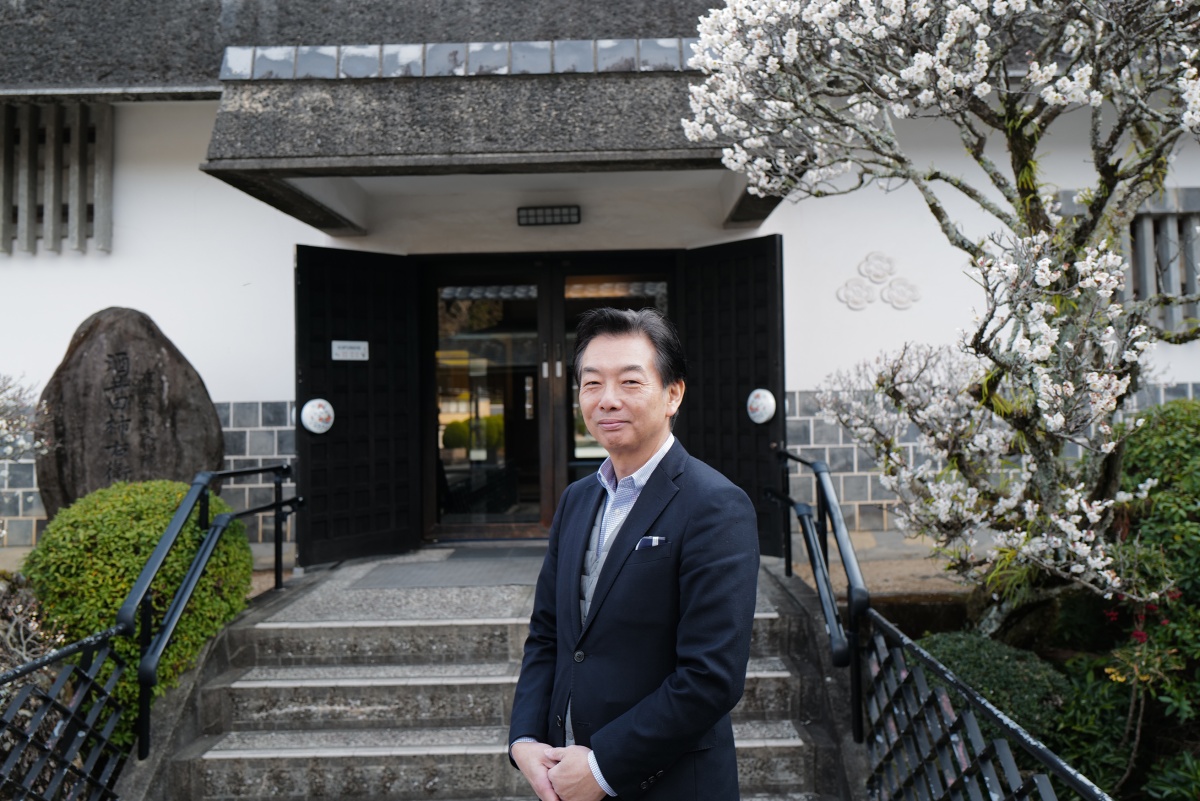
Atsushi Sakaida, Kakiemon store manager. His family has been producing porcelain for fifteen generations. Photo: Andrew Lee
Inside the Kakiemon Kiln museum in Arita, the company’s store manager, Atsushi Sakaida, stands beside a glass display case and points out two plates that, at first glance, seem have identical decorations. “The one on the right is not from Kakiemon,” he says. “It’s a European copy.”
He points to the painted enamels and tells me Kakiemon uses five pure colors, applied in pale washes, gradually deepened in intensity by the painter’s hand. European makers, however, mixed colors in advance to imitate the finished effect. Looking closer, I could see what he meant: the colors of the Kakiemon plate were lighter, more controlled, while the copy felt heavier and clumsy.
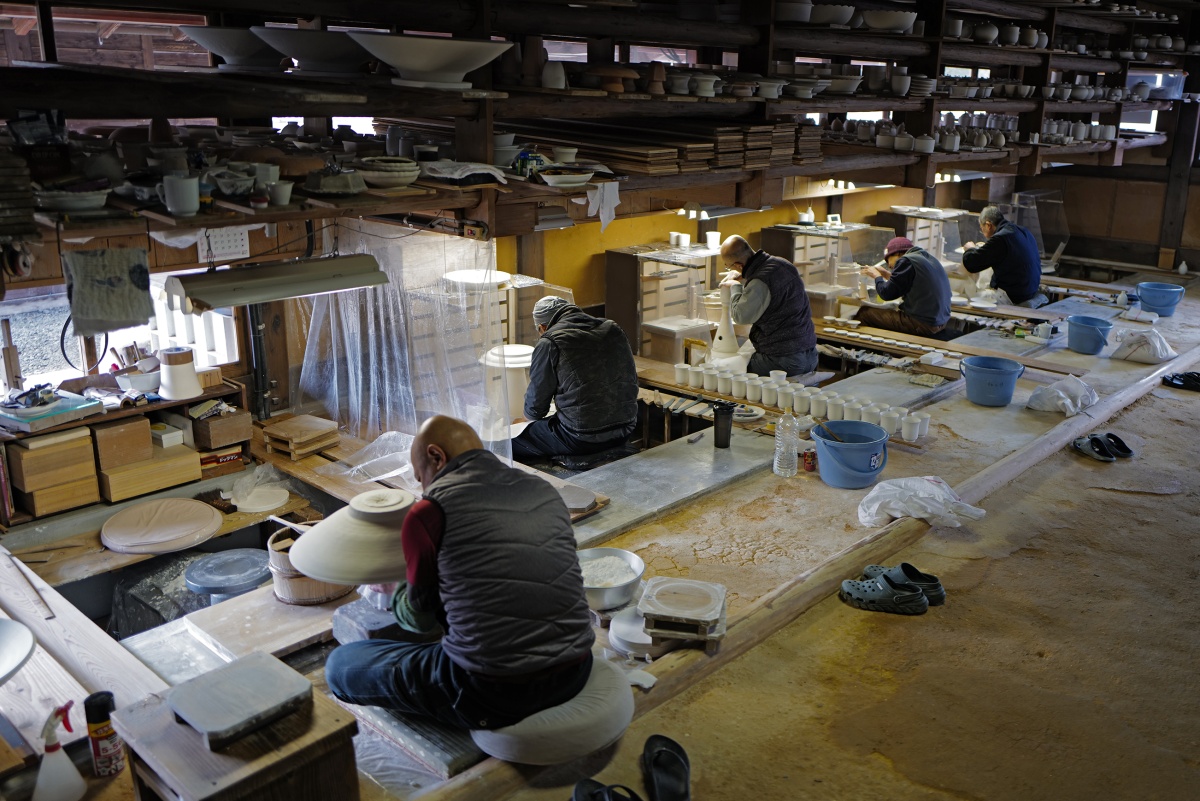
The workshop at Kakiemon Kiln. Photo: Andrew Lee
As we move to the kiln’s workshop, Sakaida slides opens the glass door, which rattles in its old wooden frame. Rows of pure white, unfired vases, bowls and plates are laid out on wooden racks on the workshop’s unsealed earthen floor. Nearby, men work in silence at potter wheels set into sunken pits, their attention fixed on the white clay they are transforming into Kakiemon’s exquisite ceramics. One stands to embrace a large spinning vase. His right arm disappears deep inside, while his left hand guides the wet clay, caressing it to its final form.
Earlier, Sakaida had shown me a photo of another plate produced in the 1600s. It was decorated with scenes of porcelain production in Arita at the time, including a workshop. Save for the electric lights and the workers’ clothing, little seems to have changed.
From Kakiemon, I head on to Arita’s Uchiyama district, where so much of the town’s porcelain history took place.
The Living Porcelain Town of Uchiyama
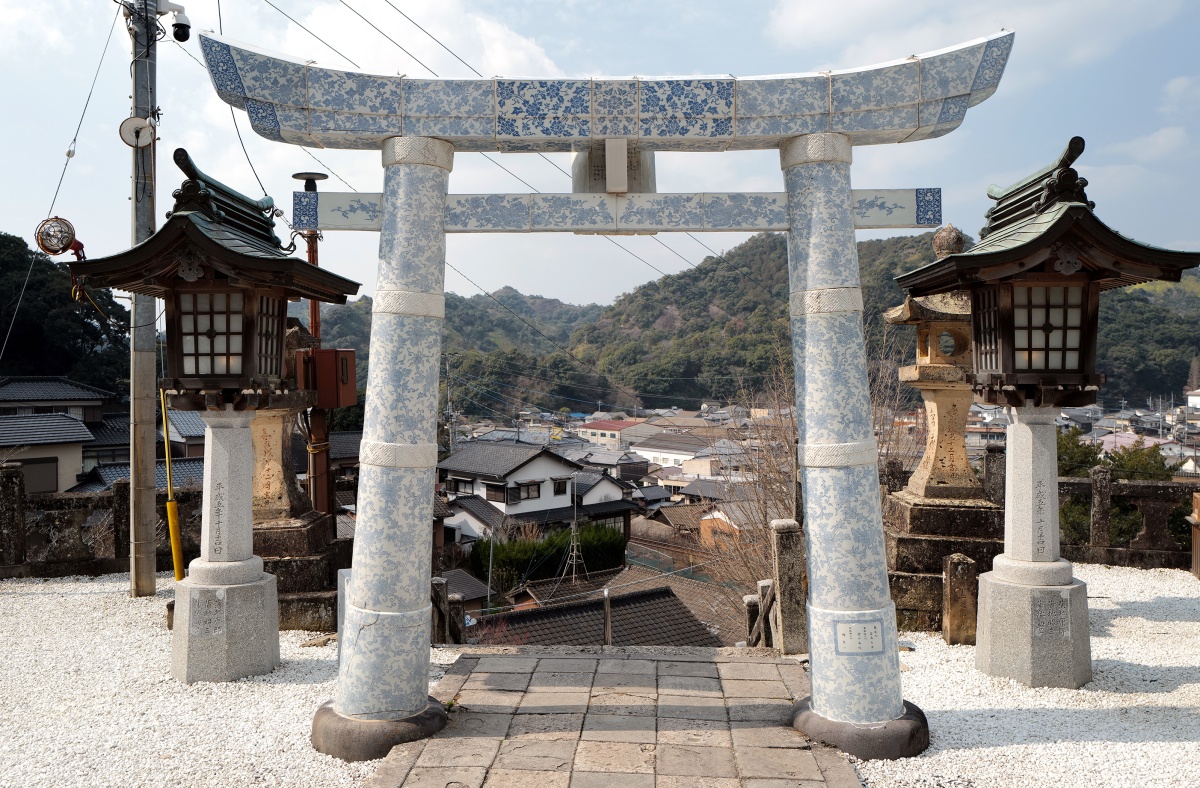
The porcelain torii at Arita's Tozan Shrine dates from 1888, and is now a designated Tangible Cultural Property. Photo: Andrew Lee
Uchiyama is Arita’s main tourist district. Its main street is Sarayama-dori, a 700-metre stretch of road lined with pottery stores and workshops, galleries, and a handful of cafes. Many of these are housed in buildings of historical interest. In August 1828, a typhoon swept through the valley and strong winds carried fire from the kilns, destroying more than 800 buildings and leaving Uchiyama in ruins.
The town that rose in its place blended traditional Japanese and Western architectural styles, and in 1991, the area was designated a National Important Preservation District. With 161 historic buildings dating from the Edo, Meiji, Taisho and early Showa periods, a walk around Uchiyama is a rare chance to experience the kind of streetscape that’s been erased from much of the country.
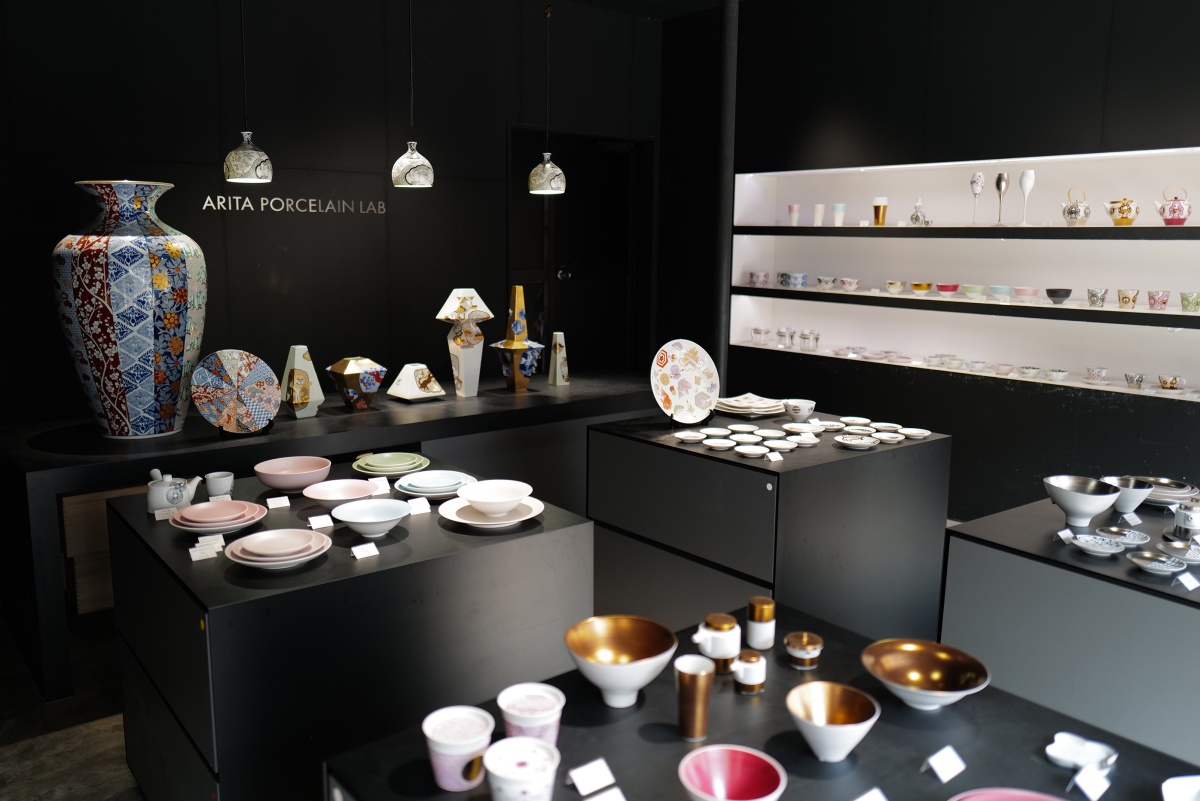
Arita Porcelain Lab on Sarayama-dori blends traditional and modern styles. Photo: Andrew Lee
Midway along Sarayama-dori is Koransha, one of Japan’s most prestigious ceramic companies. Founded in 1875, it is housed in a Western-style building, with a curved wooden staircase that leads from the ground-floor shop to a small museum upstairs. On display are pieces made for the Imperial Household and others that won awards at the Philadelphia and Paris world fairs in the late 19th century. But what caught my attention were Japan’s first porcelain insulators, developed for the telegraph line between Tokyo and Yokohama, a reminder that ceramics also helped build modern Japan.
A good contrast to Koransha is the Taisho-era machiya townhouse of Tetsuka Shoten, a little further down the street. Inside, Gallery Tetsuka represents a small roster of young ceramic artists, their work displayed among the tatami-floored rooms of the wooden shop and adjacent storehouse, built in 1913.
"What makes it unlike any other shrine in Japan is the porcelain torii gate decorated with a pale blue botan karakusa pattern of peonies and scrolling vines on white."
A few doors down is the Arita Porcelain Lab, the contemporary brand of the Yazaemon Kiln, which has been operating since 1804. Behind its flagship shop is a café where lunch and coffee are served on the company’s own tableware, featuring clean-lined pieces in matte platinum, deep wine-red and gold.
A short walk away is the Tozan Shrine, reached by crossing an active railway line and climbing a steep stone staircase. Founded in 1658, its name means "ceramic mountain shrine,” and it is dedicated to Emperor Ojin and Nabeshima Naoshige. There is also a monument to Yi Sam-pyeong on the grounds. What makes it unlike any other shrine in Japan is the porcelain torii gate decorated with a pale blue botan karakusa pattern of peonies and scrolling vines on white. Dating from 1888, the gate is now a registered Tangible Cultural Property. The komainu guardian dogs and the lanterns beside it are also made of porcelain.
From the shrine you can see Uchiyama laid out in the valley below. Later, I wandered its backstreets past old kilns and workshops.
Reviving Arita
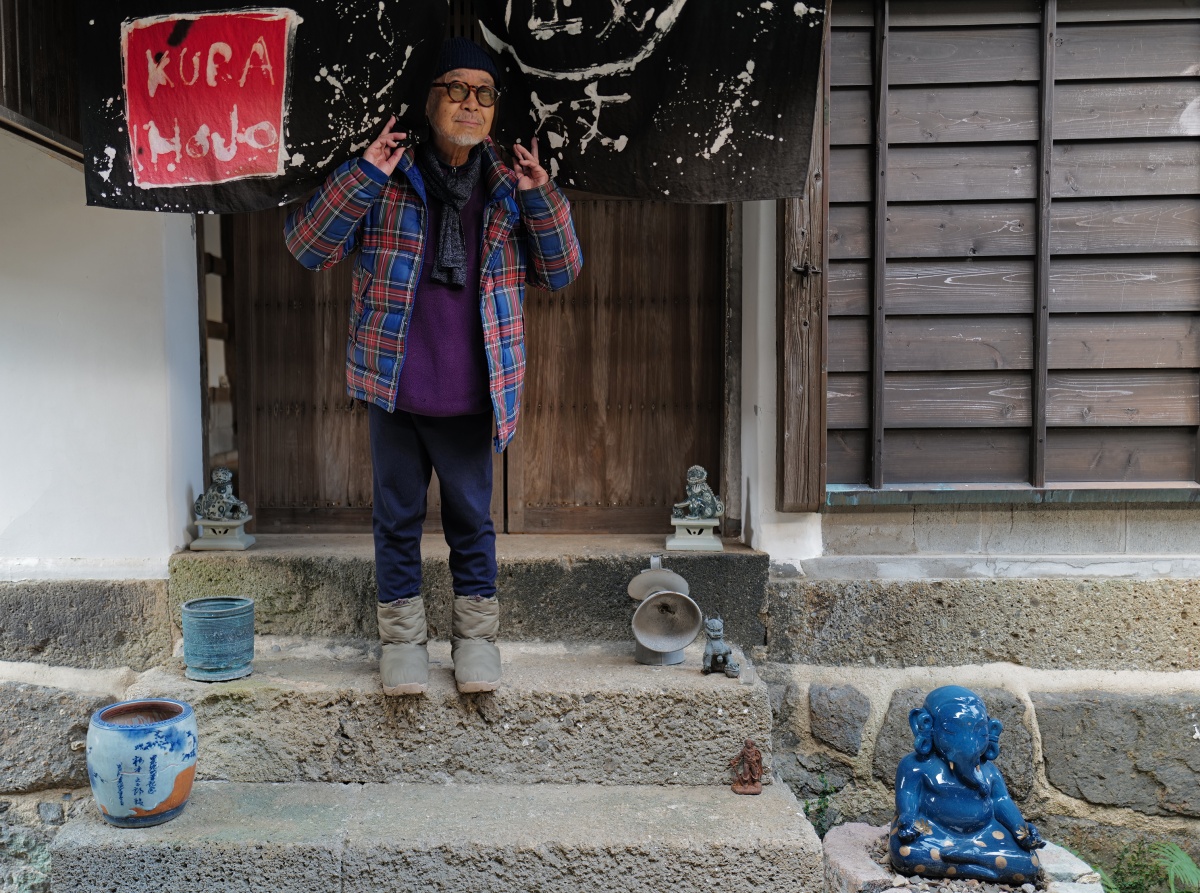
Arita-based artist Shin Koyama at Hojo Edo Machiya, one of several properties he has converted into guest accomodation in the Uchiyama district. Photo: Andrew Lee
Down a narrow alley, I walked beside one of Uchiyama’s tonbai walls, built from discarded kiln bricks. Behind it was the garden of Zoku-Ijinkan, the restored 100-year-old kominka (old folk house) where I was staying the night. At the entrance I was met by its owner, Shin Koyama.
The 79-year-old Koyama is an established artist, and a relatively new arrival to Arita. After nearly forty years in Australia, he set up a base here in 2014 and has been quietly bringing new life to the district by renovating vacant properties, known as akiya. Zoku-Ijinkan is one of three guesthouses he now operates.
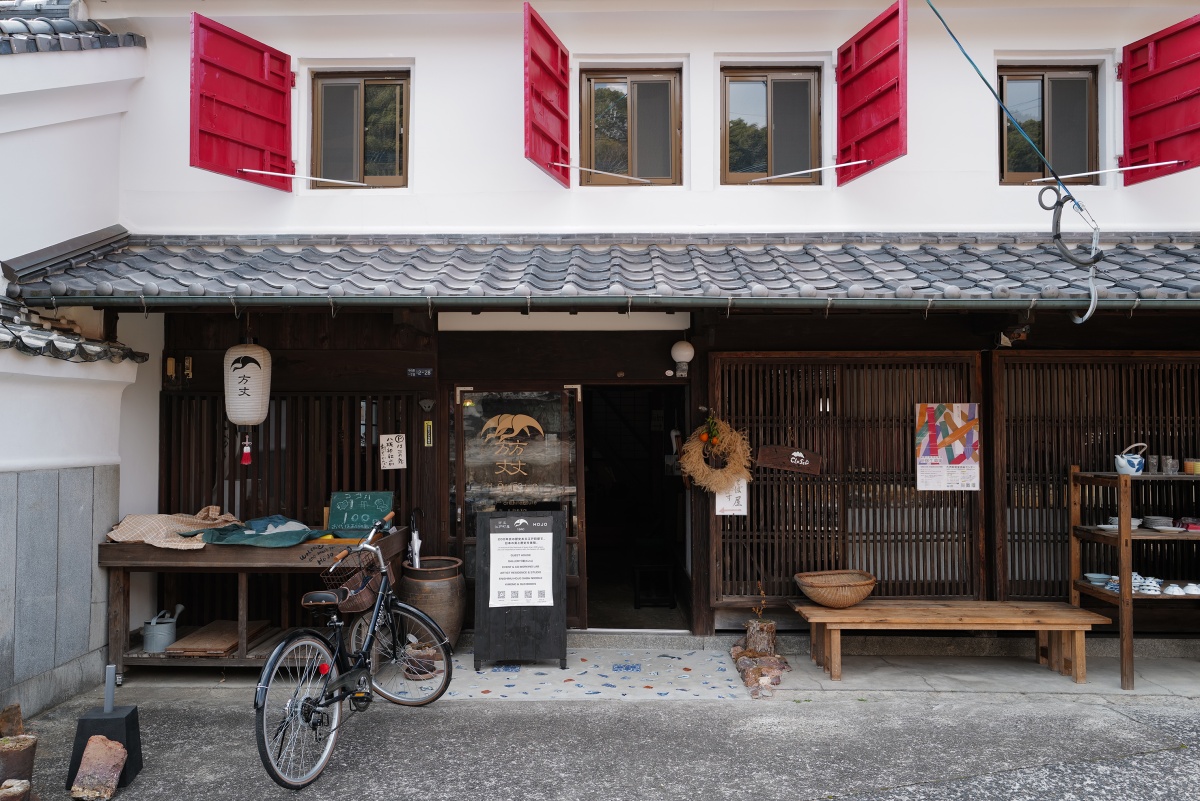
The entrance of Hojo Edo Machiya, an 1840 townhouse that has been renovated by artist Shin Koyama. Photo: Andrew Lee
He showed me around his main project, Hojo Edo Machiya, centered on an 1840 townhouse with three kura storehouses on its grounds. Koyama’s ceramics are embedded in the floor of the entrance, and more of his work is scattered through the rooms and garden. The complex encompasses guesthouse accommodation, an antique bookshop, a handmade soba restaurant and a gallery space, with a bar and Koyama’s future studio still under construction.
“It’s always so quiet in Arita,” Koyama says. “Except for the fair.” From April 29 to May 5, during the Arita Ceramics Fair, Sarayama-dori fills with hundreds of stalls and an enormous Golden Week crowd. "A million people come here for just one week in May,” he says. “There’s almost nowhere for them to stay. So most of them make it a day trip.”
The hope is that the buildings he is transforming will give people a reason to stay beyond the fair. “There are so many akiya in Arita,” he says. “They are cheap, and it’s not expensive to restore them.” The next morning, before I left, I picked up the small guest book on the kitchen table at Zoku-Ijinkan. Judging by the pages of warm messages thanking Koyama for his hospitality, he is on the right track.
The Secret Kilns of Okawachiyama
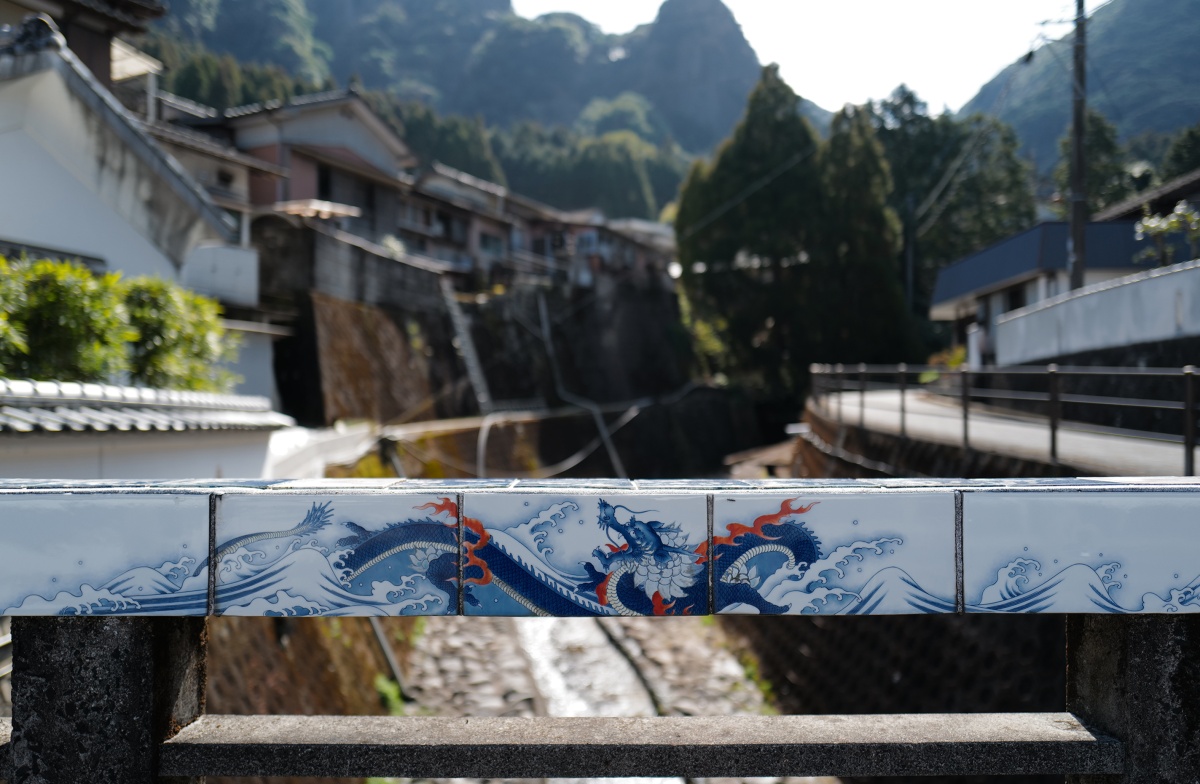
Porcelain tiles decorate Tenjin Bridge in Okawachiyama. Photo: Andrew Lee
There was one more place I wanted to visit, where I could see the other, secret side of Arita porcelain’s history.
In 1628, the ruling Nabeshima clan established its official domain kiln at Iwatani River in Arita. But in 1661, during the boom in commercial production driven by European demand, the kiln was moved to Minamikawahara, an area closer to Kakiemon where it may have benefited from their colored enamel expertise. As outside interest grew, security was stepped up to protect their secrets. In 1675, the domain kiln was moved again, this time to its final and most secluded home, Okawachiyama.
There, behind checkpoint gates, carefully selected potters worked under strict domain supervision. They were treated as samurai, granted family names and the right to carry swords, and exempted from other duties so they could devote themselves entirely to their craft. Techniques and designs were closely guarded. The wares they produced, known as Nabeshima ware, were not for sale but were meant only for presentation to the shogun and the highest ranks of the Japanese nobility.
In isolation, Nabeshima ware developed into a distinct style that was considered more technically brilliant, with a higher quality and more refined in taste than commercial Arita ware.
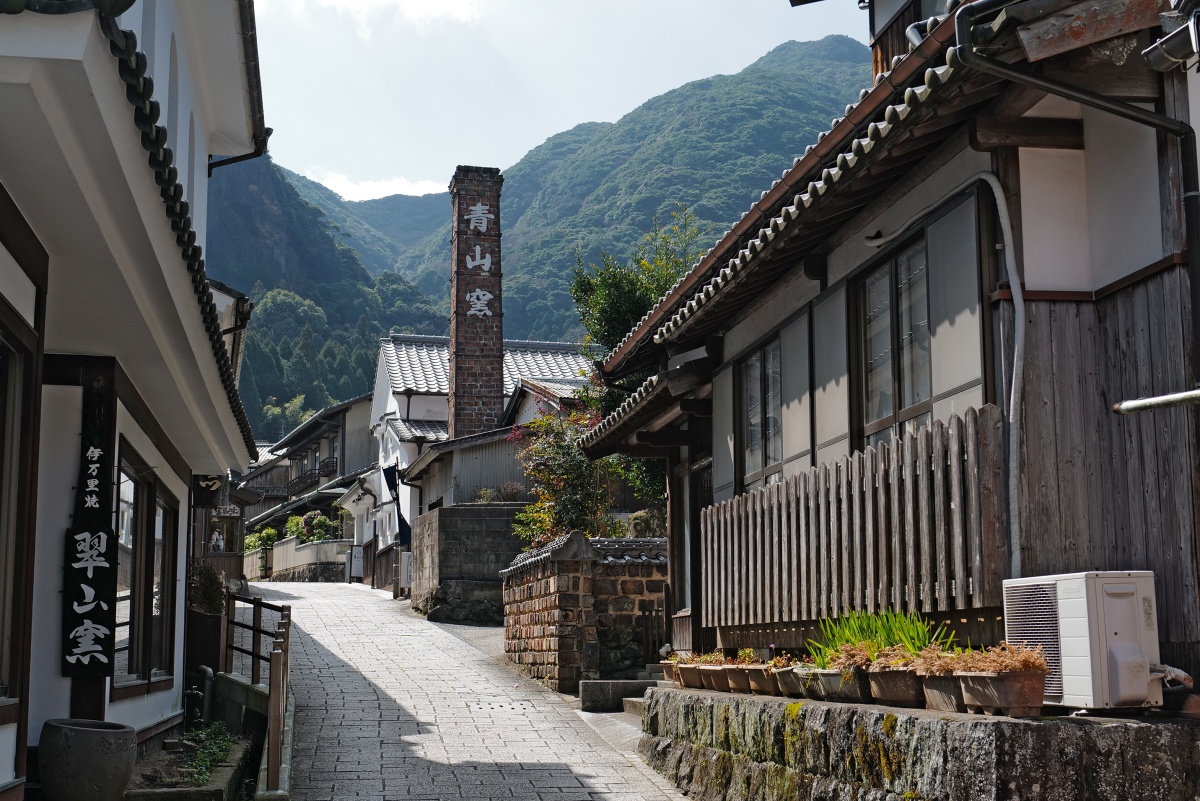
The main street of Okawachiyama. The chimney of Seizan KIln is one of several still standing in the village. Photo: Andrew Lee
The small village of Okawachiyama is still known as the “Village of the Secret Kilns,” though the secret has been out for some time, It sits at the top of a narrow valley at the end of a single mountain road, and the carpark outside the village is full when I arrive. Tourists line up to take photos of the porcelain vases perched on the parapet of the Nabeshima Clan Domain Bridge at the entrance. The bridge itself its decorated with dragon and phoenix motifs and glistens as sunlight reflects off the thousands of porcelain shards embedded in its walls.
Crammed into the village’s narrows streets are about thirty pottery stores, around twenty of which have active kilns. Several old brick chimneys rise above the village rooftops. The most prominent belongs to Seizan Kiln, which operates two spaces, one for high-end collector pieces, one for more everyday designs. Above the village, in Nabeshima Domain Park, the ruins of several Edo-period stepped kilns lie under grass, with views back down over the rooftops and chimneys below. Beside the stream running through the village center is a reconstruction of a climbing kiln that is fired up each November during the Nabeshima Clan Kiln Autumn Festival. Sections of the stone-lined waterway below are faced with ceramic tiles, and Tenjin Bridge features tiles decorated with dragons.
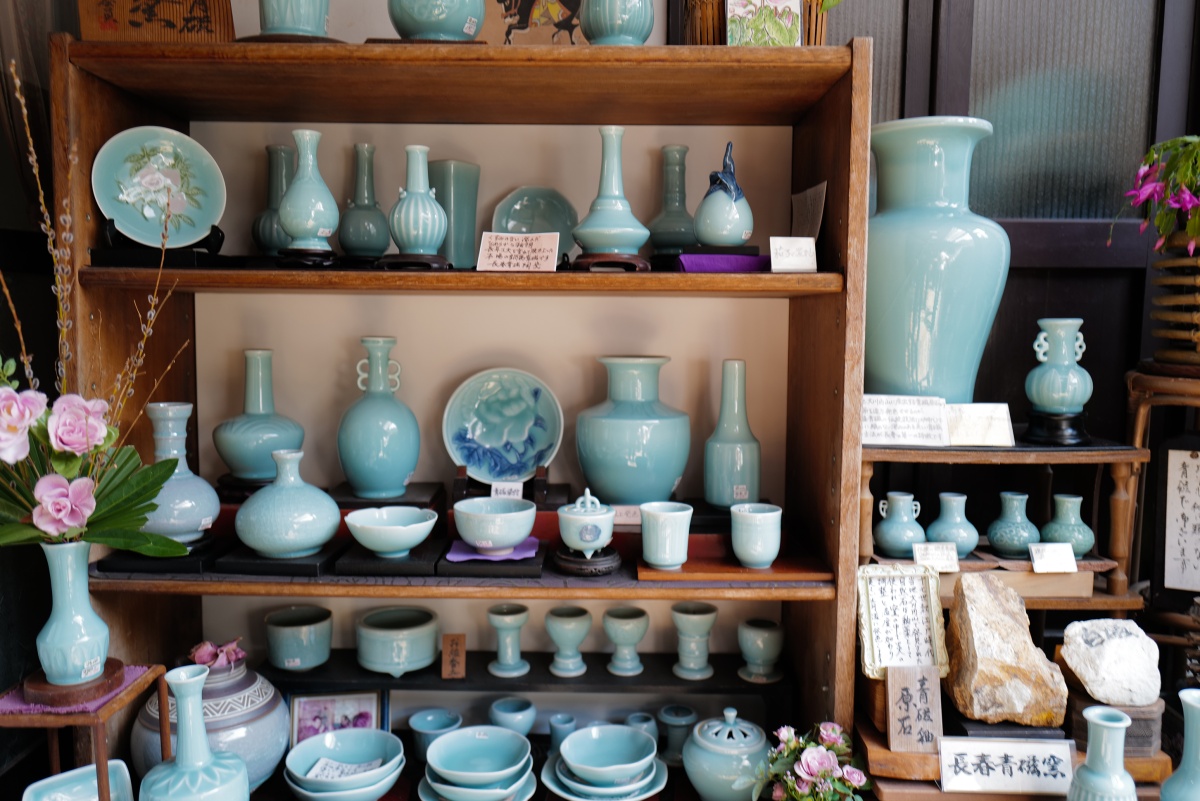
Nabeshima-seiji (celadon) at the Choshun Kiln store in Okawachiyama. Photo: Andrew Lee
In a small alley off the main street is the Choshun Kiln store, which specializes in Nabeshima-seiji (celadon), the simpler counterpart to the richly patterned iro-Nabeshima (overglaze enamel) the village is better known for. The glaze is made from a yellow stone quarried in the mountains above the village, which turns into the characteristic blue-green when fired.
As I was leaving Okawachiyama, I stepped into the Imari Toen Kiln shop, where the manager asked in English where I was from. A moment later, as I browsed, the Australian national anthem began playing over the speakers. It was absurd, but charming. In a valley once hidden behind checkpoint gates, the kilns—and Arita—now depend on outside visitors. The porcelain that made the region famous travelled the world long before most Japanese could, and that global legacy now helps sustain the place where it all began.

I'm a writer now, but have been a jack of all trades when it comes to publishing, including designer, editor, and creative director. I was at The Japan Times newspaper for 10 years, which I rebranded and redesigned in 2017. Since leaving the JT, I've been studying wine and I am currently doing the WSET Diploma. The main focus of my writing these days is the wine of Japan.
andrewlee.jp